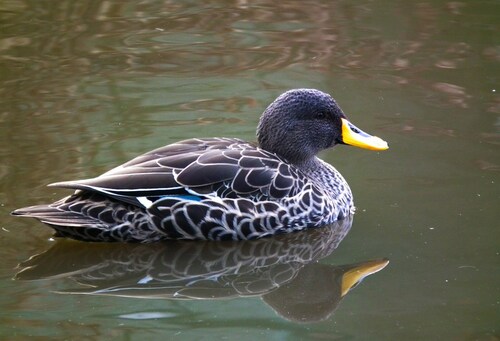
Yellow-billed Duck
Anas undulata
With its signature bright yellow bill and mottled plumage, the Yellow-billed Duck is the most common dabbler in southern Africa. A social and adaptable species, it is a delightful frequent visitor to backyard ponds and local wetlands alike.
Quick Identification
Size
Length: 51–58 cm (20–23 in); Weight: 0.5–1.3 kg (1.1–2.9 lbs)
Colors
Mottled grey and brown body with pale scalloped edges; bright yellow bill with a black stripe on the top; iridescent green to blue wing patch (speculum) bordered with white.
Key Features
- Bright yellow bill with a black saddle on the culmen
- Mottled grey-brown plumage with no sexual dimorphism
- Greenish-blue iridescent wing speculum
- Dark crown contrasting with a paler face
When You’ll See Them
Sightings on EverydayEarth
Jul 20, 2026
Four Yellow-billed Ducks are clustered together on a muddy riverbank. One duck on the left is actively preening and moving its head, displaying its bright yellow bill, while the others rest quietly against the bank.
Geographic range
Where Does the Yellow-billed Duck Live?
The Yellow-billed Duck is a quintessential African waterbird, native to the eastern and southern reaches of the continent. Its core population thrives in South Africa, extending northward through Zimbabwe, Zambia, and East Africa into the highlands of Ethiopia. While it remains within the African continent year-round, its local presence shifts as it tracks water availability across the savanna and highveld.
Basemap © OpenStreetMap contributors
Behavior
The Yellow-billed Duck is a classic dabbling duck, characteristically seen tipping its body tail-up in shallow water to reach aquatic vegetation. Unlike many other duck species, the males and females look almost identical, and both are known for their social nature. Outside of the breeding season, they are highly gregarious, often congregating in massive flocks that can number in the hundreds near stable water sources.
While they are generally wary in the wild, Yellow-billed Ducks have adapted remarkably well to human-modified landscapes. They are frequent visitors to suburban garden ponds, golf course hazards, and urban parks. They are not migratory in the traditional sense but are nomadic, wandering across the landscape to find permanent water during the dry winter months. Their presence is often announced by a typical mallard-like quack from the females and a higher-pitched whistle from the males.
EverydayEarth exclusive
Camera Tips
To capture high-quality footage of Yellow-billed Ducks, position your AI camera approximately 1 to 2 feet above the ground, facing the water's edge. These ducks prefer to 'loaf' on flat, muddy banks or low rocks near the water to preen their feathers. Aiming your camera at these basking spots rather than the open water will result in much clearer, more stable images of the birds while they are stationary.
While they are active throughout the day, the golden hour shortly after sunrise is the best time for capturing the brilliant iridescence of their green wing speculum. Yellow-billed Ducks are also quite active at night, particularly during a full moon, so ensure your camera is set to its highest sensitivity for infrared night vision. If your camera supports video, the 'dabbling' motion—where they tip vertically into the water—makes for excellent behavioral clips.
You can encourage these ducks to visit a specific spot by providing a small amount of floating waterfowl feed or cracked corn in the shallows. However, be careful not to overfeed, as decaying food can spoil the water. In a backyard setting, avoid placing the camera in areas with high wind and tall reeds, as the constant movement can cause false triggers and deplete your battery. Instead, look for a sheltered cove or a quiet corner of the pond where the ducks feel safe from predators.
Similar Species
Species that look similar or are commonly confused with Yellow-billed Duck.
Frequently Asked Questions
Record Yellow-billed Duck at your habitat
Connect a camera to start building your own species record — AI identifies every visitor automatically.