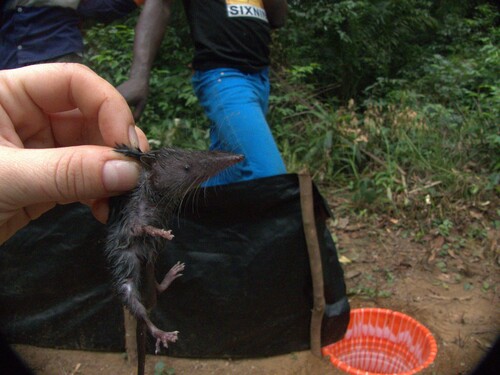
African Giant Shrew
Crocidura olivieri
The African Giant Shrew is a nocturnal powerhouse of the undergrowth. This large, musk-scented predator is a master of the African garden, providing natural pest control by hunting insects with relentless energy.
Quick Identification
Size
Head-body: 11–15 cm (4.3–6 in); Tail: 7–10 cm (2.7–4 in); Weight: 35–80 g (1.2–2.8 oz)
Colors
Uniform dark chocolate brown to slate grey upperparts; slightly paler greyish-brown underparts; tail is sparsely covered in long, protruding white hairs.
Key Features
- Long, highly mobile pointed snout with sensitive whiskers
- Exceptionally large size for a shrew species
- Musk glands on flanks that produce a pungent odor
- Tiny eyes and small, rounded ears partially hidden in fur
When You’ll See Them
Geographic range
Where Does the African Giant Shrew Live?
The African Giant Shrew is native to a massive portion of the African continent, stretching from the Atlantic coast of Senegal across the central rainforests to Ethiopia and Kenya. Its range extends northward along the Nile River into Egypt and southward into the northern regions of South Africa. This species is particularly successful because it thrives in human-modified landscapes, making it one of the most common small mammals in both rural villages and major African metropolitan areas.
Basemap © OpenStreetMap contributors
Behavior
The African Giant Shrew is a high-energy, nocturnal insectivore that spends most of its waking hours in a state of perpetual motion. Driven by an incredibly high metabolic rate, it must consume nearly its own body weight in food each day. It is a terrestrial specialist, scurrying through leaf litter, crevices, and garden debris with a distinctive zig-zagging gait, using its highly sensitive snout to sniff out prey in the darkness.
Solitary and fiercely territorial, these shrews use scent as their primary means of communication. Lateral glands on their flanks produce a strong, musky secretion used to mark trails and warn off rivals. While they are generally shy around humans, they are remarkably bold when hunting, sometimes entering homes in search of cockroaches or other pests. In the Nile Valley, they have lived alongside human civilizations for thousands of years, even appearing in ancient Egyptian animal mummies.
EverydayEarth exclusive
Camera Tips
To capture an African Giant Shrew on your trail camera, you must think low. These shrews are strictly terrestrial and rarely climb, so mount your camera no higher than 10 centimeters (4 inches) off the ground. Angle the lens slightly downward to ensure the trigger zone covers the immediate floor of the forest or garden. Because they are small and move with lightning speed, use the fastest trigger speed your camera allows and set your video mode to a high frame rate to avoid capturing nothing but a blurry brown tail.
Location is everything. Target 'micro-highways'—the narrow spaces between a garden wall and a flower bed, or the edge of a woodpile. Shrews have poor eyesight and prefer to travel while keeping their whiskers in contact with a solid surface. Placing your camera along these structural edges significantly increases your chances of a high-quality capture. Look for areas with thick leaf litter or mulch, which house the insects they crave.
Baiting is an excellent way to slow them down for a photo. A small amount of pungent wet cat food or a smear of peanut butter mixed with dried mealworms placed 1.5 to 2 meters in front of the camera works wonders. Because they are nocturnal, ensure your camera's infrared flash is clean and unobstructed. In suburban settings, positioning your camera near an outdoor light source can be effective, as the shrew will patrol the area to hunt the insects attracted to the glow.
Similar Species
Species that look similar or are commonly confused with African Giant Shrew.
Frequently Asked Questions
Record African Giant Shrew at your habitat
Connect a camera to start building your own species record — AI identifies every visitor automatically.