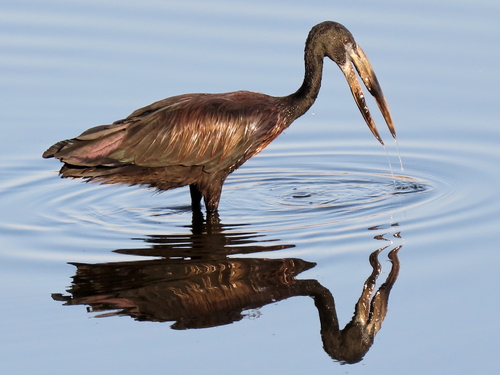
African Openbill
Anastomus lamelligerus
Master of the marshlands, the African Openbill features one of nature's most specialized tools: a nutcracker-like bill designed perfectly for shucking snails.
Quick Identification
Size
Length: 80–94 cm (31–37 in); Wingspan: 130–150 cm (51–59 in); Weight: 1–1.3 kg (2.2–2.9 lbs)
Colors
Adults are almost entirely brownish-black with a notable iridescent green, purple, and bronze sheen on the breast and mantle. The bill is a dull brownish-grey, and the legs are black. Males and females look alike.
Key Features
- Large, heavy bill with a distinct gap (open space) between the upper and lower mandibles
- Dark, iridescent brownish-black plumage
- Long, greyish-black legs
- Downward-curved lower mandible
When You’ll See Them
Geographic range
Where Does the African Openbill Live?
Native to the vast landscapes of Sub-Saharan Africa and the island of Madagascar, the African Openbill is a widespread resident across the continent. Its territory spans from the wetlands of Senegal and the Gambia in the west, across the Sahel to Ethiopia, and down through East Africa into the lush deltas of Botswana and South Africa. While they are found in many countries, their distribution is often patchy, concentrated heavily in areas with reliable seasonal flooding and high concentrations of aquatic mollusks.
Basemap © OpenStreetMap contributors
Behavior
The African Openbill is a highly specialized stork, most famous for its unique bill structure. The gap between the mandibles is not a deformity but a specialized tool designed to hold and manipulate large aquatic snails and mussels. While they are often seen foraging solo or in pairs along the muddy shorelines of wetlands, they are gregarious birds that roost and nest in large colonies, often mixing with other species like ibises, cormorants, and herons.
These storks are strong fliers and are frequently seen soaring on thermals to reach distant feeding grounds. Unlike many other stork species that are largely silent, the African Openbill is quite vocal at its nesting sites, engaging in bill-clattering and various croaking sounds. They are generally cautious around humans, but in areas where they are unmolested, they can become quite habituated to local activity, especially near rice paddies or village ponds.
EverydayEarth exclusive
Camera Tips
To capture the African Openbill on an AI-powered camera, placement is everything. These birds are 'edge specialists,' meaning they spend the majority of their time walking slowly along the very edge of shallow water or mudflats. Position your camera roughly 1 to 2 feet off the ground, mounted on a stake or low tripod, aimed toward the muddy margins of a pond or marsh. Ensure the lens is angled slightly upward if you are very close to the water to capture the full height of the bird.
The African Openbill is most active in the early morning and late afternoon when the light is soft. Because their plumage is very dark and iridescent, bright midday sun can cause 'harsh' highlights or turn the bird into a featureless black silhouette. To get the best results, set your camera to a higher ISO sensitivity if it’s in a shaded area, or use 'HDR mode' if available to capture the subtle purple and green sheen on their feathers. A fast shutter speed is essential; while they walk slowly, their bill movements when extracting a snail are lightning-fast.
If you are setting up a camera in a backyard that borders a wetland, avoid using artificial baits. Instead, maintain a natural, chemical-free environment that allows native snails and frogs to thrive, as this is the only reliable lure for this species. Be mindful of the PIR (motion sensor) sensitivity; since these are large birds, a medium sensitivity setting is usually enough to trigger the camera from 15-20 feet away without being set off by moving reeds or water ripples. Finally, consider using a camera with a 'Burst Mode' or 'Photo Series' setting to catch the specific moment the bird uses its 'open' bill to pry apart a shell.
Similar Species
Species that look similar or are commonly confused with African Openbill.
Asian Openbill
Very similar bill shape but has a much lighter, greyish-white plumage compared to the African species' dark brown-black feathers.
Abdim's Stork
Similar size and dark color, but lacks the gap in the bill and has a white belly and lower back.
Glossy Ibis
Also dark and iridescent, but much smaller with a thin, downward-curved bill that has no gap.
Frequently Asked Questions
Record African Openbill at your habitat
Connect a camera to start building your own species record — AI identifies every visitor automatically.