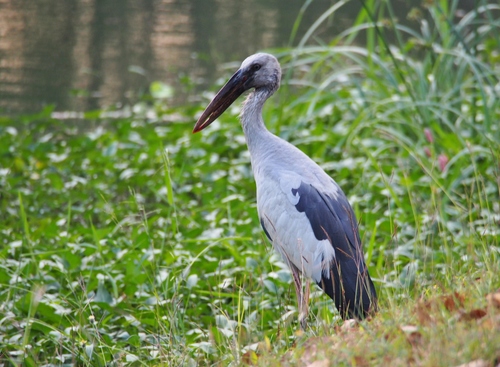
Asian Openbill
Anastomus oscitans
A specialist of the marshlands, the Asian Openbill is famous for the unique 'nutcracker' gap in its bill. This elegant white and black stork is a vital part of the agricultural ecosystem across Southern Asia.
Quick Identification
Size
Length: 68-81 cm (27-32 in); Wingspan: 147-152 cm (58-60 in); Weight: 1.3-1.9 kg (2.9-4.2 lbs)
Colors
Body is white or pale grey; flight feathers and tail are glossy black; bill is dull brownish-grey; legs are pinkish to dull red.
Key Features
- Notable gap between the arched upper and curved lower mandibles
- Large, heavy grey bill
- Contrast of white body plumage against black wings and tail
- Long, reddish-pink legs and neck
When You’ll See Them
Geographic range
Where Does the Asian Openbill Live?
The Asian Openbill is a quintessential bird of the Southern Asian tropics, found extensively across the Indian subcontinent and Southeast Asia. Its native range stretches from the river basins of Pakistan and India through the lush wetlands of Bangladesh and Myanmar into Thailand, Cambodia, and Vietnam. While these storks are generally residents of their home regions, they are highly mobile nomads, frequently traveling long distances across national borders to find optimal water levels and food sources as the monsoon seasons shift.
Basemap © OpenStreetMap contributors
Behavior
The Asian Openbill is a highly specialized wading bird known primarily for its unique bill structure. While it may look like a deformity, the gap between its mandibles is a sophisticated tool for gripping and extracting large snails from their shells. They are diurnal birds, spending their mornings foraging in shallow waters and their afternoons soaring on thermals or resting in communal roosts. They are social creatures, often feeding in small groups and nesting in massive colonies that can include hundreds of pairs.
Unlike many other storks that are silent, the Asian Openbill can be quite vocal at the nest, producing various clattering sounds with its bill. In agricultural areas, they have developed a commensal relationship with humans, frequently following plows in rice paddies to snatch up disturbed prey. While they are generally wary of close human approach, they are a common and accepted sight in rural villages across their range.
EverydayEarth exclusive
Camera Tips
To successfully capture the Asian Openbill on a backyard or trail camera, focus your efforts on the 'mud line.' These birds are most active at the very edge of shallow water where snails congregate. Position your camera on a low tripod or stake, roughly 18 to 24 inches off the ground, and angle it slightly upward. This perspective highlights the bird's incredible bill and long legs, making for a much more dramatic shot than a top-down angle.
Because the Asian Openbill is a large, mostly white bird, lighting can be a challenge. If your camera allows for exposure adjustments, underexpose by one stop during the middle of the day to prevent 'blowing out' the white feathers in bright sunlight. The best captures often happen during the golden hours—shortly after sunrise or before sunset—when the light is softer and the birds are most active in their foraging routine.
If you live near rice paddies or marshland, you don't necessarily need bait, but a water feature with a gradual, muddy slope is a natural magnet. Avoid deep ponds with steep sides, as these storks prefer to walk and wade rather than swim. High-speed video settings are highly recommended; the speed at which they can manipulate a snail shell is remarkable, and seeing this behavior in slow motion provides incredible insight into their specialized evolution.
Similar Species
Species that look similar or are commonly confused with Asian Openbill.
Frequently Asked Questions
Record Asian Openbill at your habitat
Connect a camera to start building your own species record — AI identifies every visitor automatically.