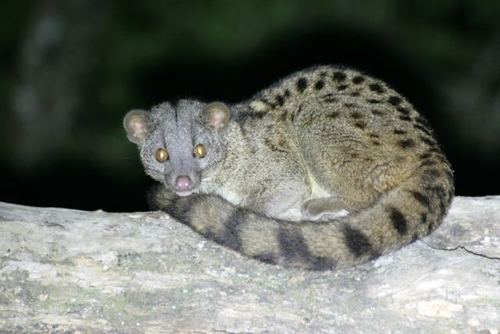
African Palm-civet
Nandinia binotata
The African Palm-civet is an ancient survivor of the canopy, easily identified by its twin shoulder spots and incredible climbing agility. A unique member of the African ecosystem, it bridges the gap between the wild forest and suburban gardens.
Quick Identification
Size
Head and body length of 17-23 inches (44-58 cm), plus a 18-24 inch (46-62 cm) tail; weight ranges from 3.7 to 4.6 lbs (1.7-2.1 kg).
Colors
Tawny to dull brown fur with small dark spots; two distinct cream-colored spots on the shoulders; tail features 12-15 dark rings.
Key Features
- Two prominent light-colored shoulder spots
- Long, thick tail used for arboreal balance
- Short, rounded ears and large, cat-like eyes
- Dark spots arranged in irregular rows along the back
When You’ll See Them
Geographic range
Where Does the African Palm-civet Live?
The African Palm-civet is widely distributed across the tropical belt of Sub-Saharan Africa. It is found from the coastal forests of Guinea and Sierra Leone in West Africa, through the dense Congo Basin of Central Africa, and eastward into the montane forests of Kenya, Uganda, and Tanzania. This resilient mammal thrives across a broad range of altitudes and is a common resident in countries like Cameroon, Gabon, and Nigeria, wherever sufficient tree cover and fruit sources are available.
Basemap © OpenStreetMap contributors
Behavior
The African Palm-civet is a fascinating, solitary creature that lives almost exclusively in the forest canopy. Despite their resemblance to cats or weasels, they belong to a primitive lineage of carnivores that is genetically distinct from all others. They are strictly nocturnal, spending their daylight hours curled up in the safety of tree hollows or thick vines, only emerging after sunset to begin their nightly foraging rounds.
In the wild, these animals are highly territorial. Both males and females use specialized scent glands on their palms and abdomen to mark their paths through the branches. They are vocal animals, often identified by their eerie, loud 'hoo' calls that echo through the night forest. While they are usually shy and avoid human contact, they have adapted well to human-modified landscapes and are frequently seen in fruit orchards or on the edges of suburban neighborhoods where forest cover remains.
EverydayEarth exclusive
Camera Tips
Capturing the African Palm-civet on a backyard or trail camera requires an arboreal approach. Because they spend about 80% of their time in the trees, a camera mounted 10 to 15 feet off the ground will be significantly more successful than a ground-level setup. Look for thick, horizontal branches or 'bridges' where different tree canopies touch, as these are the primary highways for these agile climbers.
If you must place your camera on the ground, position it at the base of a known fruiting tree, such as a fig, oil palm, or papaya tree. African Palm-civets will descend to the ground to move between isolated trees. Using a scent lure or bait can keep them in the frame longer; they are highly attracted to the smell of overripe fruit. Smearing mashed banana or honey on a tree trunk about four feet high is a proven method to get a clear, stationary shot of the animal's face and markings.
Since these animals are strictly nocturnal, your camera's infrared capabilities are vital. Set the camera to 'High' sensitivity to capture their quick movements through the leaves. Video mode is particularly rewarding for this species, as it captures their unique 'tail-balancing' behavior and their distinctive vocalizations. During the wet season, they may be more active during short breaks in the rain, so ensure your camera has fresh batteries to handle high-trigger frequency during those windows.
Similar Species
Species that look similar or are commonly confused with African Palm-civet.
Frequently Asked Questions
Record African Palm-civet at your habitat
Connect a camera to start building your own species record — AI identifies every visitor automatically.