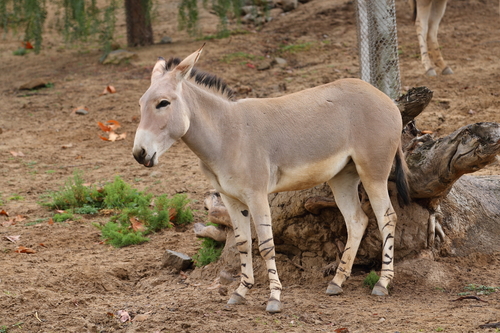
African Wild Ass
Equus africanus
The stoic ancestor of the domestic donkey, the African Wild Ass is a critically endangered icon of the Horn of Africa. With its striking zebra-striped legs and incredible desert stamina, it is a living testament to evolutionary resilience.
Quick Identification
Size
Shoulder height of 1.25–1.45 m (4.1–4.8 ft); weight ranges from 230–275 kg (510–610 lb).
Colors
Light gray to yellowish-fawn coat with a white underbelly; distinctive horizontal black stripes on the legs; dark dorsal stripe.
Key Features
- Zebra-like horizontal black stripes on the lower legs
- Large ears with black margins and white interiors
- Short, erect dark-tipped mane without a forelock
- Slender, narrow hooves adapted for rocky terrain
When You’ll See Them
Geographic range
Where Does the African Wild Ass Live?
Native to the northeastern corner of Africa, the African Wild Ass is now restricted to fragmented populations within the Horn of Africa. It primarily resides in the rocky deserts and arid plains of Eritrea, Ethiopia, and parts of Somalia. Historically, its range was far more extensive, stretching across North Africa into Sudan and Egypt, but it is now one of the rarest large mammals on the planet.
Basemap © OpenStreetMap contributors
Behavior
The African Wild Ass is a master of desert survival, adapted to thrive in some of the world's most inhospitable environments. They are highly resilient, capable of losing up to 30% of their body weight in water and recovering quickly after drinking. Unlike many equids that form permanent herds, their social structure is fluid and loose; females and foals often move in small, temporary groups, while mature stallions are solitary and highly territorial, guarding access to precious water sources.
These animals are primarily crepuscular, focusing their activity during the cooler dawn and dusk hours to avoid the intense midday heat of the Danakil Desert. They communicate through loud, resonant brays that can carry for miles across the flat plains, helping individuals maintain contact in low-density populations. Despite their rugged appearance, they are incredibly sure-footed and can gallop across steep, volcanic scree slopes with ease.
EverydayEarth exclusive
Camera Tips
Capturing the African Wild Ass on camera is a significant challenge due to their extreme rarity and wariness. The most effective strategy is to locate permanent water holes or 'tinajas' during the dry season. Because they must drink at least once every few days, these water sources serve as the primary focal point for all wildlife in the region. Place your camera roughly 3 to 4 feet high on a sturdy rock or tripod, ensuring it is well-camouflaged to match the volcanic terrain.
Given the intense desert sun, avoid placing cameras where they will face directly into the sunrise or sunset to prevent lens flare. Use a camera with a fast trigger speed (under 0.3 seconds) and a high-quality PIR sensor, as these animals often travel along ridge lines or across wide-open flats where they may only pass through the frame for a moment. Wide-angle lenses are preferable to capture the animal's full profile against the dramatic desert backdrop.
Nighttime and twilight performance is critical. Ensure your camera uses 'No-Glow' infrared LEDs, as these wild equids are sensitive to light and may be spooked by even a faint red glow from standard IR arrays. If you are monitoring a trail, look for 'dust baths'—depressions in the sand where they roll to clean their coats—as these are high-traffic areas that provide excellent opportunities for behavioral shots.
Similar Species
Species that look similar or are commonly confused with African Wild Ass.
Frequently Asked Questions
Record African Wild Ass at your habitat
Connect a camera to start building your own species record — AI identifies every visitor automatically.