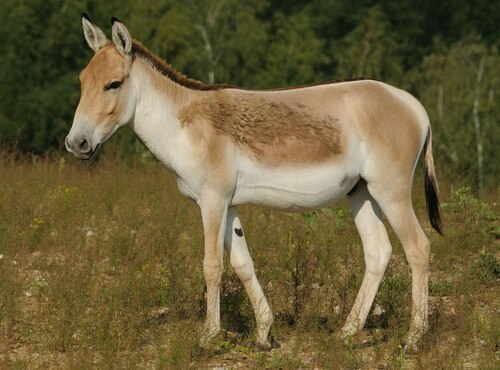
Onager
Equus hemionus
The Onager is the desert's endurance athlete, a wild and hardy equid that thrives in the vast steppes of Asia. Known for its incredible speed and striking dorsal stripe, seeing one is a true bucket-list moment for any wildlife enthusiast.
Quick Identification
Size
Shoulder height of 1.1 to 1.5 meters (3.6 to 4.9 feet); weight between 200 and 260 kg (440 to 570 lbs).
Colors
Pale sandy to reddish-brown coat with a white underbelly and legs; a distinct dark brown stripe runs down the center of the back.
Key Features
- Distinct dark dorsal stripe from mane to tail
- Short, upright mane with no forelock
- Slender, horse-like legs with small hooves
- White 'mealy' muzzle and pale eye rings
When You’ll See Them
Behavior
These wild asses are known for their territorial nature, especially during the breeding season. Dominant males will fiercely guard access to water sources or patches of high-quality grazing land. Despite their rugged reputation, they are naturally shy and have excellent eyesight and hearing, often detecting movement from over a kilometer away and fleeing before a human can get close.
EverydayEarth exclusive
Camera Tips
Capturing an Onager on a trail camera requires a strategy focused on water and transit corridors. In the arid landscapes they inhabit, permanent water sources are magnets. Position your camera 3 to 4 feet off the ground, mounted to a sturdy post or a large rock. Angle the lens slightly downward toward the water's edge, but keep the camera at least 15 feet away to ensure the animal's large frame stays within the field of view. These are big animals, and a camera placed too close will only capture a wall of fur.
Because Onagers are extremely wary, use a camera with 'No-Glow' or 'Black' infrared LEDs. They have keen senses and may be spooked by the faint red glow of standard IR flashes. A fast trigger speed (under 0.4 seconds) is non-negotiable; Onagers often approach water at a trot and don't linger long if they sense something is amiss. Set your camera to a 3-shot burst or a 20-second video clip to capture their social interactions, as they rarely travel alone.
In wide-open steppes where there are no trees or water, look for 'dust baths'—depressions in the earth where the animals roll to clean their coats and discourage parasites. These are excellent secondary locations for camera placement. If you are mounting a camera in an area with high winds, ensure the mount is rock-solid to prevent 'false triggers' from moving sand or dry brush. During the summer heat, focus your camera's active hours on the crepuscular periods (dawn and dusk) when these animals are most active and the lighting is most dramatic for photography.
Similar Species
Species that look similar or are commonly confused with Onager.
Frequently Asked Questions
Record Onager at your habitat
Connect a camera to start building your own species record — AI identifies every visitor automatically.