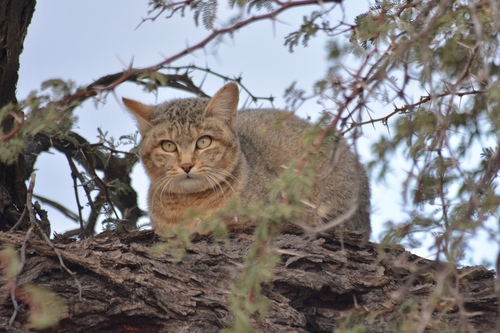
African Wildcat
Felis lybica
The ghost of the savanna and the direct ancestor of our domestic companions. The African Wildcat is a master of stealth, thriving in environments ranging from the scorched Kalahari to the fringes of your backyard.
Quick Identification
Size
Body length 45–75 cm (18–30 in); tail length 20–38 cm (8–15 in); weight 3–6.5 kg (6.6–14.3 lb)
Colors
Sandy-grey to yellowish fur with faint vertical stripes; reddish-brown tint on the backs of the ears; black-tipped tail with distinct dark rings.
Key Features
- Reddish-brown color on the back of the ears
- Longer legs than domestic cats, providing an upright 'tall' sitting posture
- Black-tipped tail with 2-3 distinct dark rings
- Faint vertical stripes on the flanks and dark bands on the legs
When You’ll See Them
Geographic range
Where Does the African Wildcat Live?
The African Wildcat is native to the vast landscapes of Africa and Southwest Asia, possessing one of the most extensive distributions of any small wild cat. Its core range stretches across the African continent—excluding only the deepest rainforests and the driest centers of the Sahara—and extends through the Arabian Peninsula into Central Asia, reaching as far east as the Rajasthan desert in India and the Xinjiang province of China. While they are a wide-ranging species, their population purity is most intact in remote regions of Southern and Eastern Africa, far from the influence of domestic cat populations.
Basemap © OpenStreetMap contributors
Behavior
The African Wildcat is a master of stealth and a primarily solitary hunter. While they are capable of being active during the day in undisturbed areas, they are predominantly nocturnal and crepuscular, timing their movements with the activity of their rodent prey. They are highly territorial, using scent marking and vocalizations similar to domestic cats to define their home ranges, which can vary significantly in size depending on the availability of food and water.
In terms of social interaction, these cats are generally elusive and avoid human contact, though they are frequently found on the outskirts of rural and suburban settlements where rodents are plentiful. This proximity to humans has led to a significant conservation challenge: hybridization with domestic cats. In the wild, they are patient stalkers, using cover to get within pouncing distance of prey before delivering a precise strike. Despite their fierce independence, their DNA is the primary ancestor of the modern house cat, a lineage that began with their self-domestication in the Near East roughly 10,000 years ago.
EverydayEarth exclusive
Camera Tips
Capturing a high-quality image of an African Wildcat requires precise camera placement, as these felines are incredibly agile and often stick to the shadows. Position your camera at 'knee-height'—roughly 30 to 40 centimeters off the ground—and angle it parallel to the earth rather than downward. This low angle is crucial for capturing the diagnostic features of the species, specifically the reddish-brown fur behind the ears and the length of the legs, which are the primary ways to distinguish them from feral domestic cats.
Look for 'micro-trails' or fence lines near the edges of scrubland or agricultural fields. African Wildcats often use these man-made or natural corridors to patrol their territory. If you are using a trail camera, prioritize a model with a fast trigger speed (0.3 seconds or less) and a 'no-glow' infrared flash. These cats have highly sensitive vision and can be spooked by the faint red glow of standard infrared LEDs, causing them to bolt or avoid the area in the future.
While food baiting is often discouraged as it attracts unwanted scavengers like hyenas or domestic dogs, scent lures can be highly effective. A small amount of valerian root or even a piece of carpet soaked in catnip placed on a sturdy branch can pique their curiosity and encourage them to linger in front of the lens. In drier environments, placing your camera near a permanent water hole or a leaking irrigation pipe is almost a guarantee for a sighting, especially during the twilight hours when they come to drink before the night's hunt.
Seasonally, you may find them more active in the open during the cooler winter months. During the peak of summer, they will likely only appear in the dead of night. Adjust your camera settings to 'burst mode' (3-5 photos per trigger) to ensure you get at least one clear shot of the tail rings or the profile of the head, which are essential for confirming a wildcat identification versus a hybrid.
Similar Species
Species that look similar or are commonly confused with African Wildcat.
Frequently Asked Questions
Record African Wildcat at your habitat
Connect a camera to start building your own species record — AI identifies every visitor automatically.