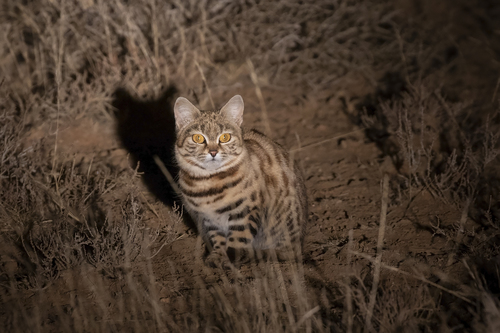
Black-footed Cat
Felis nigripes
Widely considered the world's deadliest feline, the tiny Black-footed Cat is a master of the African night. This pint-sized powerhouse is a rare and rewarding find for any trail camera enthusiast exploring the arid south.
Quick Identification
Size
Body length of 35–52 cm (14–20 in) with a weight range of 1.1–2.45 kg (2.4–5.4 lbs)
Colors
Tawny-gold or cinnamon-buff fur covered in bold black spots and stripes; legs feature thick black horizontal bars; tail is ringed with a black tip.
Key Features
- Distinctive black or dark brown soles on the feet
- Bold black horizontal bars on the legs and neck
- Smallest feline in Africa, smaller than a domestic cat
- Large, rounded ears and a broad skull
When You’ll See Them
Geographic range
Where Does the Black-footed Cat Live?
The Black-footed Cat is native to the arid Southern African subregion. Its core range is concentrated in the dry interior of South Africa, stretching across the Kalahari and Karoo regions into Namibia and southern Botswana. While there are sporadic records in southern Zimbabwe and Angola, the species is highly localized to these semi-desert landscapes and does not inhabit the more humid regions of the continent.
Basemap © OpenStreetMap contributors
Behavior
The Black-footed Cat is a strictly nocturnal and highly solitary hunter. Despite its diminutive size—it is the smallest wild cat in Africa—it has earned a reputation as the world's deadliest feline. It possesses a metabolic rate much higher than other cats, requiring it to hunt almost continuously throughout the night, often killing up to 14 small prey animals in a single evening with a staggering 60% success rate.
These cats are primarily terrestrial and are poor climbers, preferring to stay low to the ground to stalk rodents and small birds. They are notoriously shy and will seek refuge at the slightest sign of disturbance, usually retreating into abandoned termite mounds or springhare burrows. Because of their secretive nature and preference for remote, arid environments, they rarely interact with humans and are almost never seen in suburban settings.
EverydayEarth exclusive
Camera Tips
Capturing a Black-footed Cat on camera is a significant achievement for any wildlife enthusiast. Because they are the smallest cats in Africa, you must mount your camera extremely low—no higher than 15 to 20 centimeters (6 to 8 inches) off the ground. If the camera is mounted at standard deer or leopard height, you will likely miss them entirely or only capture the top of their ears. Angle the camera slightly upward if the terrain is uneven.
These cats are incredibly fast and reactive, so prioritize a camera with a lightning-fast trigger speed (0.2 seconds or less) and a high recovery time. Set your camera to 'Burst Mode' or 'Photo + Video' to increase your chances of getting a clear shot of their markings, as they rarely stand still for long. High-quality Infrared (IR) flash is essential; avoid 'white flash' cameras as the sudden light will likely scare the cat away and prevent it from returning to that spot.
Look for 'micro-highways' in the landscape: dry washouts, gaps under fences, or paths leading toward active termite mounds or springhare burrows, which they use as dens. In arid environments, a small, reliable water source or 'seep' is an irresistible draw. If legal in your area, a small amount of olfactory lure—such as a commercial feline scent—can encourage them to pause and sniff, giving the camera enough time to trigger. Avoid using food bait that might attract larger predators like jackals, which could scare the cat away.
Similar Species
Species that look similar or are commonly confused with Black-footed Cat.
Frequently Asked Questions
Record Black-footed Cat at your habitat
Connect a camera to start building your own species record — AI identifies every visitor automatically.