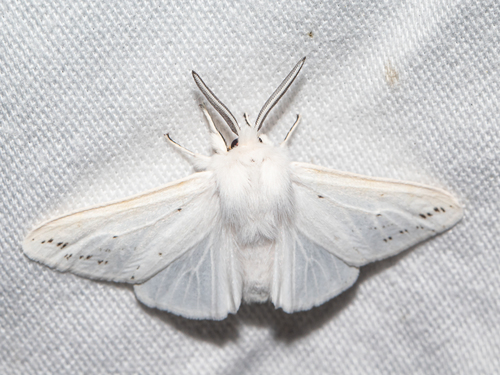
Agreeable Tiger Moth
Spilosoma congrua
With its pristine white wings and charming orange 'socks,' the Agreeable Tiger Moth is a peaceful nocturnal visitor to backyards across North America. Easily identified by its striking black eyes, this moth is a favorite for evening nature observers.
Quick Identification
Size
Wingspan of 2.5–4.5 cm (1–1.75 inches); body length approx 1.5–2 cm (0.6–0.8 inches)
Colors
Brilliant snowy white wings and body; distinctive orange or yellow 'bib' markings on the forelegs; large, solid black eyes
Key Features
- Pure white wings with very few or no black spots
- Bright orange-yellow coloring on the front legs
- Prominent, deep black eyes
- Wings held in a steep tent-like shape when at rest
When You’ll See Them
Geographic range
Where Does the Agreeable Tiger Moth Live?
This moth is native to the North American continent, with a broad distribution that covers most of the United States and southern Canada. It is particularly prevalent throughout the Eastern and Central United States, from the Atlantic coast to the edge of the Great Plains, where temperate conditions and garden landscapes provide ample host plants for their larvae. While less common in the deep deserts of the West, they are a staple of backyard biodiversity across the Midwest and Atlantic regions.
Basemap © OpenStreetMap contributors
Behavior
The Agreeable Tiger Moth is a nocturnal insect frequently found fluttering around porch lights and suburban gardens during the warmer months. Unlike many other tiger moths that use bright colors to warn predators of their toxicity, this species relies on its clean, white appearance to blend into pale surfaces or light-colored foliage. When resting, it adopts a characteristic 'tent' posture, folding its wings steeply over its back to hide its abdomen and legs.
As larvae, these moths are generalist feeders that move slowly across the ground in search of leafy greens. They are part of the 'woolly bear' group, though they appear more straw-colored or brownish than the iconic black-and-orange banded variety. The adults are relatively docile and 'agreeable' to observe, often remaining perfectly still on a wall or sheet for hours, which makes them excellent subjects for backyard nature enthusiasts.
EverydayEarth exclusive
Camera Tips
Capturing the Agreeable Tiger Moth requires a different approach than photographing mammals or birds. Because they are nocturnal and attracted to light, the most effective method is to set up a 'moth sheet.' Hang a white cotton sheet and shine a strong UV or mercury vapor light against it. Position your AI-powered camera on a tripod facing the sheet at a distance of about 2 feet. This setup creates a high-contrast background that makes the moth's white wings and black eyes pop in photos.
Since traditional trail cameras use Passive Infrared (PIR) sensors triggered by heat, they may not detect a moth. To bypass this, use a camera with 'Time Lapse' mode or a specialized macro-wildlife camera that uses pixel-change detection. Set the capture interval to every 60 seconds during the peak activity hours of 10 PM to 1 AM. This ensures you catch the moths as they land and settle on the sheet.
For the best detail, ensure your camera's focus is locked on the surface of the sheet or a specific vertical post where moths are likely to land. High humidity and warm, moonless nights are the 'golden hours' for moth activity. If your camera has a macro lens attachment, use it; the orange 'bib' on the Agreeable Tiger Moth’s legs is its most distinguishing feature but requires a close-up shot to be clearly visible for AI identification.
Similar Species
Species that look similar or are commonly confused with Agreeable Tiger Moth.
Frequently Asked Questions
Record Agreeable Tiger Moth at your habitat
Connect a camera to start building your own species record — AI identifies every visitor automatically.