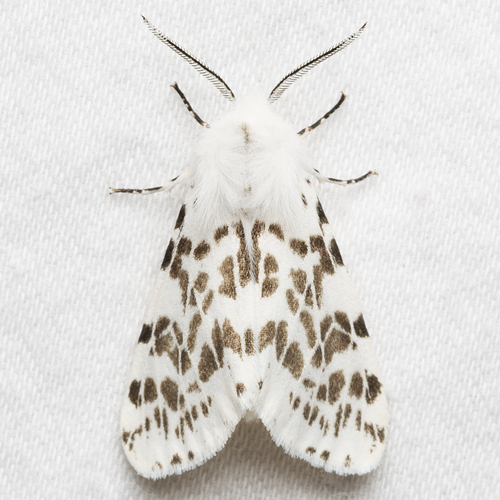
Fall Webworm Moth
Hyphantria cunea
Famous for the massive silk 'tents' their caterpillars build in late summer, the adult Fall Webworm Moth is a stunning, snowy-white visitor to the night garden.
Quick Identification
Size
Wingspan of 30–42 mm (1.2–1.7 in); body length roughly 15–20 mm (0.6–0.8 in)
Colors
Brilliant snowy white wings, occasionally marked with small black spots; legs often show orange or yellow at the base
Key Features
- Solid white or black-spotted white wings
- Densely 'furry' white thorax
- Orange or yellow markings on the femur of the front legs
- Comb-like feathery antennae in males
When You’ll See Them
Geographic range
Where Does the Fall Webworm Moth Live?
The Fall Webworm Moth is native to the North American continent, stretching from southern Canada through the entire United States and into northern Mexico. Because of its adaptability, it has become a successful invasive species across much of the Northern Hemisphere, establishing large populations throughout East Asia and parts of Europe. In its introduced range, particularly in China and Japan, it is a significant concern for agriculturalists and urban foresters alike.
Basemap © OpenStreetMap contributors
Behavior
The Fall Webworm Moth is best known for its gregarious larval stage. The caterpillars are famous for spinning expansive, silken tents over the tips of tree branches during the late summer months. These nests serve as both a communal dining hall and a fortress against predators. Unlike tent caterpillars, which build nests in the crotches of tree trunks, webworms start at the ends of branches and expand the silk as they consume more foliage.
As adults, these moths are strictly nocturnal and remarkably short-lived. Once they emerge from their cocoons, they typically do not eat, focusing their limited energy entirely on finding a mate and laying eggs on the undersides of leaves. While they are often viewed as pests due to the unsightly appearance of their larval nests, they rarely cause permanent damage to healthy, established trees, making them a fascinating, low-impact resident of the backyard ecosystem.
EverydayEarth exclusive
Camera Tips
To capture high-quality images of the adult Fall Webworm Moth, your best strategy is to utilize their strong attraction to light. Set up a white sheet in your backyard and illuminate it with a UV 'black light' or a mercury vapor lamp. Mount your camera on a tripod approximately 2-3 feet from the sheet, using a macro lens or a camera with a short minimum focus distance. Because these moths are white, they can easily 'wash out' in photos; try reducing your exposure compensation or lowering the intensity of your flash to preserve the detail in their wings.
If you prefer a more natural setting, position your camera near known host trees like Mulberry, Black Walnut, or Pecan. Look for the distinctive silk nests during the day and set up your camera nearby for the evening. Adult moths often rest on the foliage surrounding these sites. Since they are most active in the middle of the night, ensure your camera's night vision or external flash is ready to trigger on small subjects.
For those using AI-powered backyard cameras, place the device near a porch light or an automated garden light. Because the moths are relatively small, you may need to adjust your camera's sensitivity settings to 'High' to ensure the motion sensor triggers. Early summer and late summer are the best times to catch the two main 'broods' of adults in most temperate regions.
Similar Species
Species that look similar or are commonly confused with Fall Webworm Moth.
Virginian Tiger Moth
Larger and has more distinct black spots on the wings and yellow-orange bands on the abdomen.
Eastern Tent Caterpillar Moth
The adult is reddish-brown with two pale diagonal stripes, unlike the snowy white Fall Webworm.
White Ermine
Has many more numerous and prominent black spots across the entire wing surface.
Frequently Asked Questions
Record Fall Webworm Moth at your habitat
Connect a camera to start building your own species record — AI identifies every visitor automatically.