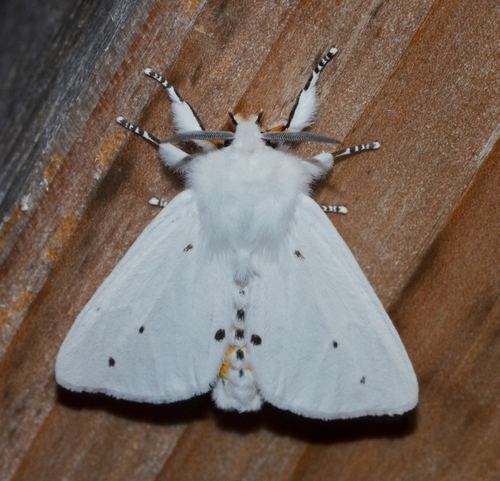
Virginian Tiger Moth
Spilosoma virginica
Known for its pristine white wings and its fuzzy 'Yellow Bear' caterpillar, the Virginian Tiger Moth is a common but beautiful visitor to North American gardens. This hardy insect thrives from coast to coast, bridging the gap between wild forests and suburban backyards.
Quick Identification
Size
Wingspan of 3.2 to 5.2 cm (1.25 to 2 in); larvae grow up to 5 cm (2 in) in length
Colors
Adults are pure white with tiny black spots; the abdomen has yellow-orange sides with a row of black dots
Key Features
- Snow-white wings with sparse black speckling
- Yellow-to-orange abdomen with black dorsal spots
- Densely hairy 'woolly' caterpillar with variable white, yellow, or orange coloration
When You’ll See Them
Geographic range
Where Does the Virginian Tiger Moth Live?
The Virginian Tiger Moth is a native resident of North America, where it enjoys a massive geographic footprint. Its range extends from the Atlantic coast all the way to the Pacific, covering nearly the entire continental United States. It is also found throughout the southern provinces of Canada, particularly in areas with temperate climates that support its wide variety of host plants. This adaptability allows it to thrive in both lush rural environments and densely populated urban centers.
Basemap © OpenStreetMap contributors
Behavior
Adult Virginian Tiger Moths are primarily nocturnal, spending their nights seeking mates and their days resting quietly on the undersides of foliage. They are frequently attracted to artificial light sources, which is often how homeowners first encounter them. Despite their bright white appearance, they are masters of remaining still and inconspicuous during daylight hours to avoid predation.
The larval stage, commonly known as the Yellow Woolly Bear, is far more active and visible than the adult. These caterpillars are famous for their rapid crawling speed as they migrate between host plants or search for pupation sites in the fall. Unlike the closely related Isabella Tiger Moth (the banded woolly bear), which is said to predict winter, the Virginian version is more uniform in color but equally hardy, surviving cold temperatures by producing a natural antifreeze in its tissues.
EverydayEarth exclusive
Camera Tips
To capture the Virginian Tiger Moth on your backyard camera, the most effective strategy is to leverage their attraction to light. Set up your camera facing a white wall or a hung bedsheet illuminated by a UV 'black light' or a standard porch bulb. This setup, known as a moth sheet, provides a flat, high-contrast background that makes it much easier for AI identification software to pick out the moth's white silhouette and the subtle black spots on its wings.
For capturing the caterpillar stage, the 'Yellow Woolly Bear,' you should move your camera to ground level. Position the lens about 6 to 10 inches off the ground along the edge of a garden bed or a walkway. These caterpillars are quite mobile in late summer and autumn; a camera with a fast trigger speed is essential as they can move surprisingly quickly across the field of view.
When photographing or filming the adults, be wary of 'white-out' caused by your camera's flash. Because these moths are incredibly bright white, a standard infrared or white LED flash can overexpose the image, erasing the delicate black dots that distinguish them from other white moth species. If possible, use a diffused light source or adjust your camera's exposure settings downward to preserve the fine details of the wings and the colorful abdomen segments.
Similar Species
Species that look similar or are commonly confused with Virginian Tiger Moth.
Fall Webworm Moth
Smaller in size and lacks the bright yellow-orange coloring on the sides of the abdomen.
Agreeable Tiger Moth
Very similar but usually has a pure white abdomen without the yellow/orange lateral patches found on the Virginian.
Isabella Tiger Moth
The adult is tan or yellowish rather than pure white, and the caterpillar is the famous black-and-orange banded woolly bear.
Frequently Asked Questions
Record Virginian Tiger Moth at your habitat
Connect a camera to start building your own species record — AI identifies every visitor automatically.