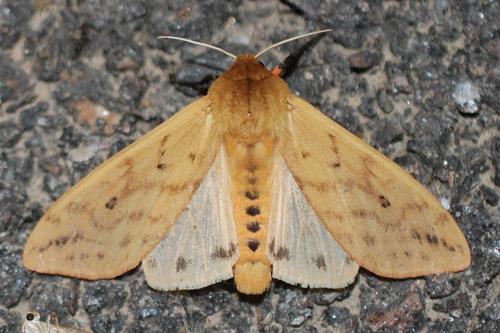
Isabella Tiger Moth
Pyrrharctia isabella
Famous for the 'woolly bear' caterpillar stage, the Isabella Tiger Moth is a master of winter survival. This hardy insect transforms from a fuzzy autumn wanderer into a beautiful, buff-colored nocturnal moth.
Quick Identification
Size
Wingspan 4.5–6.5 cm (1.8–2.5 in); Larvae reach up to 5 cm (2 in) in length
Colors
Adults are dull yellow-orange or buff with small black spots on wings; Larvae are famously banded with black ends and a rusty-red center
Key Features
- Densely hairy 'woolly bear' larvae with distinct black and rust-colored segments
- Adult moths feature buff-colored wings with rows of small, faint black dots
- Robust, fuzzy thorax and abdomen with dark dorsal spotting
When You’ll See Them
Geographic range
Where Does the Isabella Tiger Moth Live?
This resilient moth is native to North America and boasts an incredibly wide distribution that spans from the subarctic regions of Canada and Alaska down through the entire contiguous United States and into northern Mexico. It is a highly adaptable species found in nearly every terrestrial habitat within this range, from sea-level coastal plains to high-altitude mountain meadows. Because it can survive extreme cold, it is one of the few moth species that thrives in both the freezing northern territories and the humid subtropical southern states.
Basemap © OpenStreetMap contributors
Behavior
The Isabella Tiger Moth is perhaps best known for its larval stage, the banded woolly bear. During the autumn, these caterpillars become highly visible as they wander in search of a sheltered spot to spend the winter. They are famous for their survival strategy; they produce a natural antifreeze called glycerol, which allows them to survive being frozen solid during the winter months. Once spring arrives, they thaw out, feed briefly, and then spin a cocoon made of their own silk and body hairs.
The adult moths are nocturnal and significantly less conspicuous than the larvae. They emerge in late spring or summer to mate and lay eggs. While they do not feed as adults, their primary focus is reproduction. They are frequently attracted to artificial light sources, where they can be seen resting with their wings folded in a roof-like shape over their bodies.
EverydayEarth exclusive
Camera Tips
To capture the Isabella Tiger Moth in its adult form, you should focus on light-attraction setups. Placing your camera near a porch light or a dedicated UV 'blacklight' trap during humid summer nights is the most effective strategy. Aim the camera at a flat, light-colored surface like a white wall or a hung sheet, where the moths are likely to land and remain still for several minutes.
If you are looking to document the 'woolly bear' caterpillar stage, ground-level placement is key. During the fall, set your trail camera to its macro or 'close-up' setting if available, and position it along the edge of a garden path or a lawn. These caterpillars are most active on warm, sunny afternoons as they seek out overwintering sites, so ensure your camera is positioned to catch the low-angled autumn sun which will highlight their 'woolly' texture.
For the best results with a backyard AI camera, focus on areas with high concentrations of host plants like dandelions or clover. Since the caterpillars move relatively slowly, a high-frequency trigger or a short video mode is ideal for capturing their undulating movement. In the spring, keep an eye on the undersides of logs or leaf litter where they pupate; you might catch the moment a fresh adult emerges from its fuzzy cocoon.
Similar Species
Species that look similar or are commonly confused with Isabella Tiger Moth.
Virginian Tiger Moth
The adult is pure white rather than buff, and its caterpillar (the 'Yellow Bear') is usually pale yellow or tan rather than black and rust.
Salt Marsh Moth
Adults have white forewings with more numerous black spots and yellow-orange hindwings (in males), and the larvae lack the distinct three-banded color pattern.
Frequently Asked Questions
Record Isabella Tiger Moth at your habitat
Connect a camera to start building your own species record — AI identifies every visitor automatically.