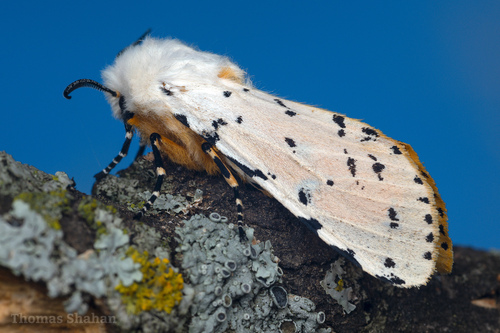
Salt Marsh Moth
Estigmene acrea
A snowy white beauty with a hidden splash of orange, the Salt Marsh Moth is a master of adaptation found from Canadian meadows to Colombian forests. Look for its iconic 'woolly bear' caterpillars scurrying through your garden in late summer.
Quick Identification
Size
Wingspan of 4.5–6.8 cm (1.75–2.7 in); larvae reach up to 5 cm (2 in) in length
Colors
Snowy white forewings with small black spots; males have orange hindwings, while females have white hindwings; abdomen is bright orange with black dots
Key Features
- White forewings with scattered black dots
- Bright orange abdomen with a central row of black spots
- Males feature yellow-orange hindwings
- Densely hairy 'woolly bear' style caterpillars
When You’ll See Them
Geographic range
Where Does the Salt Marsh Moth Live?
The Salt Marsh Moth is a widespread inhabitant of the North American continent, ranging from southern Canada across the entire United States. Its territory extends southward through Mexico and Central America, reaching as far as Colombia in South America. This broad distribution makes it one of the most commonly encountered tiger moths in the Western Hemisphere, thriving in almost any environment with ample low-growing vegetation.
Basemap © OpenStreetMap contributors
Behavior
The Salt Marsh Moth is a prominent member of the tiger moth subfamily, recognized for its striking white wings and vibrant abdominal markings. Despite its name, this moth is a generalist and is just as comfortable in a suburban backyard or a midwestern cornfield as it is in a coastal marsh. Adults are strictly nocturnal and are famously attracted to artificial light sources, where they can often be found resting on walls or screens during the summer months.
In their larval stage, these moths are one of several species known as 'woolly bears.' These caterpillars are exceptionally fast-moving and are often seen crossing paths or roads in late summer. Unlike some other hairy caterpillars, they do not possess stinging hairs, though their dense bristles can cause mild irritation to sensitive skin. They are solitary creatures, spending their days voraciously consuming a wide variety of host plants to fuel their transformation.
EverydayEarth exclusive
Camera Tips
To successfully capture the Salt Marsh Moth on an AI-powered camera, you should capitalize on their intense attraction to light. The best setup involves hanging a white cotton sheet against a wall or fence and illuminating it with a UV 'black light' or a strong LED floodlight. Position your camera on a tripod approximately 2 to 4 feet away from the sheet, ensuring the focus is sharp on the texture of the fabric where the moths will land.
Because these moths are white and highly reflective, they can easily become 'blown out' or overexposed in night photos. If your camera allows for exposure adjustment, dial it down slightly. Use a high-sensitivity motion setting, or better yet, set your camera to a time-lapse mode (one photo every 30 seconds) during the peak hours of 10 PM to 1 AM to ensure you catch them as they land and settle.
For the 'woolly bear' caterpillar stage, place your camera just a few inches off the ground near garden edges or stone walkways. Use a wide-angle lens if possible and set the trigger to the fastest response time. These caterpillars move surprisingly quickly, and a slow trigger might only capture a blurry tail. Late August and September are the best times to find the larvae as they wander in search of pupation sites.
Similar Species
Species that look similar or are commonly confused with Salt Marsh Moth.
Frequently Asked Questions
Record Salt Marsh Moth at your habitat
Connect a camera to start building your own species record — AI identifies every visitor automatically.