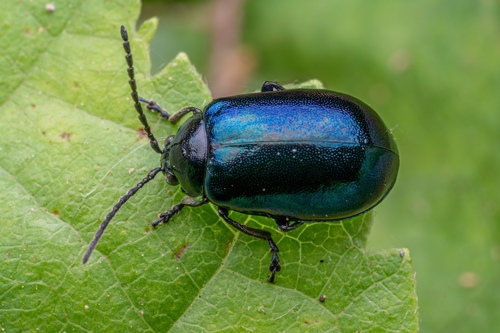
Alder Leaf Beetle
Agelastica alni
A miniature marvel of metallic violet, the Alder Leaf Beetle turns backyard trees into living lace. Watch this shimmering insect thrive in damp woodlands and garden edges across the temperate world.
Quick Identification
Size
6–7 mm (0.23–0.28 inches) in length
Colors
Shimmering metallic dark blue to deep violet-black; antennae and legs are also dark
Key Features
- Deep metallic blue or violet elytra (wing cases)
- Oval-shaped, convex body
- Length of 6–7 mm
- Black larvae that skeletonize leaves
When You’ll See Them
Geographic range
Where Does the Alder Leaf Beetle Live?
Native to a vast expanse of the Northern Hemisphere, the Alder Leaf Beetle is naturally found across Europe, through the Caucasus, and into the frigid reaches of Siberia and north-eastern Kazakhstan. In the 19th century, this species was introduced to the United States, where it has since established itself in the Northeast and the Pacific Northwest. It thrives wherever its specific host trees are found, particularly in temperate regions with high moisture levels.
Basemap © OpenStreetMap contributors
Behavior
Alder Leaf Beetles are fascinating insects known for their boom-and-bust population cycles. Adults emerge from their winter slumber in the soil or leaf litter as soon as the spring temperatures rise, typically in April or May. They immediately seek out their namesake host trees to begin feeding on fresh spring foliage. After mating, females lay bright yellow egg clusters on the undersides of leaves, which hatch into dark, gregarious larvae.
These beetles are not solitary; they are often found in large aggregations, which can lead to dramatic 'skeletonizing' of trees where only the leaf veins remain. Despite the heavy visual damage they cause, they rarely kill mature trees. Interactions with humans are passive, as they are harmless to people, though gardeners may find their numbers overwhelming during peak years. By late summer, the larvae drop to the ground to pupate, and a second generation of adults emerges briefly before finding a spot to hibernate for the winter.
EverydayEarth exclusive
Camera Tips
Capturing the Alder Leaf Beetle requires a different approach than filming birds or mammals. Because of their small size, you will need a camera with macro capabilities or a dedicated macro lens. Position your camera extremely close to the foliage of an Alder tree—look for leaves that already show signs of feeding damage (holes or lacy patterns). A branch at eye level that receives plenty of sunlight is the ideal 'studio' for these metallic insects.
Lighting is the most critical factor for a great shot. The beetle's shell is highly reflective and metallic; in direct, harsh midday sun, it can cause 'blown-out' white spots in your footage. Aim for a spot that receives bright, filtered light. This will bring out the deep violets and blues of their elytra without the distracting glare. If you are using a trail camera, ensure it has a very close focal range (some macro-capable cameras can focus within a few inches).
To attract them specifically to your camera's field of view, you don't need traditional bait. Instead, look for 'suckers'—the fresh, soft new growth at the base of an Alder tree. These tender leaves are highly attractive to both adults and larvae. If you can safely secure a branch in front of your lens without damaging the tree, you can create a consistent feeding station that beetles will visit throughout the day.
Consider using a time-lapse setting if your camera supports it. Watching a group of black larvae systematically skeletonize a leaf over the course of several hours makes for a compelling wildlife study. Because they are most active during the warmest part of the day, set your camera's PIR sensor to high sensitivity to catch their small movements, or use a timer to record during the peak hours of 10 AM to 4 PM.
Similar Species
Species that look similar or are commonly confused with Alder Leaf Beetle.
Frequently Asked Questions
Record Alder Leaf Beetle at your habitat
Connect a camera to start building your own species record — AI identifies every visitor automatically.