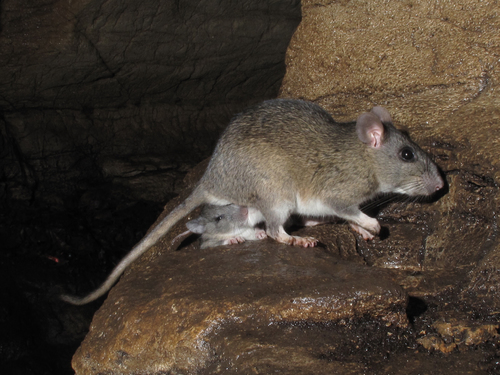
Allegheny Woodrat
Neotoma magister
Meet the 'pack rat' of the Appalachians, a furry-tailed architect that turns rocky cliffs into treasure-filled homes. Unlike common rats, the Allegheny woodrat is a shy, clean specialist of the wilderness.
Quick Identification
Size
Total length: 35-45 cm (14-18 in); Tail: 15-20 cm (6-8 in); Weight: 200-450 g (7-16 oz)
Colors
Soft brownish-gray upperparts, creamy white underbelly and feet, and a distinctly bicolored furred tail (dark gray above, white below).
Key Features
- Fully furred, non-scaly tail
- Large, prominent ears and dark, bulging eyes
- Exceptionally long whiskers (vibrissae) reaching 5 cm or more
- Pure white fur on the paws
When You’ll See Them
Geographic range
Where Does the Allegheny Woodrat Live?
The Allegheny woodrat is native to the Appalachian Mountains of North America. Its core range extends from the Hudson Highlands in New York southward through Pennsylvania and West Virginia into Kentucky, Tennessee, and northern Georgia. While historically found further north, its current distribution is largely restricted to high-elevation rocky terrains within the eastern United States.
Basemap © OpenStreetMap contributors
Behavior
The Allegheny woodrat is a fascinating "pack rat" known for its obsessive habit of collecting and hoarding non-food items. These rodents build complex, multi-generational nests called middens within protected rocky crevices. In these middens, researchers often find "treasures" such as shiny bottle caps, feathers, colorful stones, and bits of plastic, which the woodrat uses to decorate or structuralize its home.
Primarily nocturnal and solitary, these mammals are highly territorial over their rock-sheltered domains. Unlike the more common Norway rat, the Allegheny woodrat is a clean, shy animal that rarely enters human homes, preferring the isolation of cliffs and caves. They are incredibly agile climbers, capable of navigating vertical rock faces with ease using their long whiskers to sense their surroundings in total darkness.
EverydayEarth exclusive
Camera Tips
To capture the Allegheny woodrat on your AI camera, location is everything. You must place your camera near their specific geological niche: look for deep crevices in rock faces, talus slopes (piles of large rocks), or the mouths of small caves. These woodrats rarely travel more than a few dozen yards from the safety of these rocks, so positioning the camera directly at a "runway" along a cliff base or a flat rock ledge is your best bet.
Mount your camera low to the ground, roughly 6 to 10 inches high. Because they are strictly nocturnal, high-quality infrared (IR) night vision is essential. Avoid using white flash cameras, as these are shy animals that may be easily spooked from their territory. If you find a midden—a pile of sticks and forest debris—do not disturb it, but set your camera nearby to record the woodrat's architectural activities.
For baiting, these woodrats are highly attracted to high-fat mast and sweet fruits. A small pile of unsalted sunflower seeds, walnuts, or apple slices placed on a conspicuous "stage" rock will encourage them to linger for a clear photo. For a unique challenge, try leaving a safe, shiny object like a silver coin or a clean bottle cap near the bait; you may catch footage of the woodrat swapping a piece of food for the treasure!
Similar Species
Species that look similar or are commonly confused with Allegheny Woodrat.
Frequently Asked Questions
Record Allegheny Woodrat at your habitat
Connect a camera to start building your own species record — AI identifies every visitor automatically.