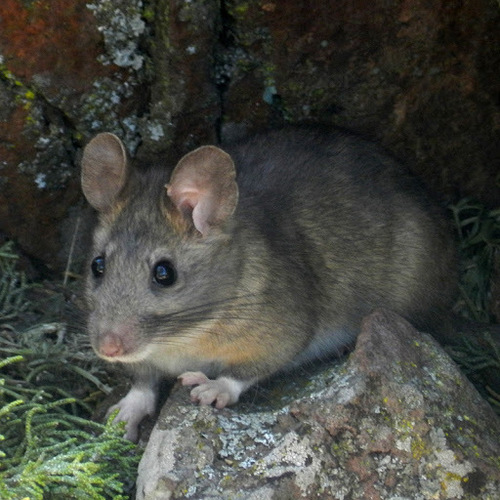
Bushy-tailed Woodrat
Neotoma cinerea
Often mistaken for a squirrel due to its magnificent plume of a tail, the Bushy-tailed Woodrat is nature's most dedicated collector. From mountain peaks to abandoned cabins, this nocturnal architect builds sprawling 'middens' that can last for centuries.
Quick Identification
Size
Total length of 11-18 inches (28-46 cm); weight ranges from 6 to 21 ounces (175-600 g)
Colors
Soft grey-brown to reddish-brown fur on the back with a starkly white belly and feet; tail is thick, bushy, and typically grey
Key Features
- Long squirrel-like bushy tail
- Large rounded ears with thin fur
- Extremely long, prominent whiskers
- White fur on the underside and paws
When You’ll See Them
Geographic range
Where Does the Bushy-tailed Woodrat Live?
The Bushy-tailed Woodrat is native to western North America. Its range extends from the subarctic regions of the Yukon and Northwest Territories in Canada, stretching southward through the Rocky Mountains and the Pacific Northwest, and reaching as far as the high-altitude regions of Arizona and New Mexico in the United States. This species is a true specialist of the mountain west, thriving in both lush temperate forests and arid, rocky landscapes.
Basemap © OpenStreetMap contributors
Behavior
Bushy-tailed Woodrats are famous for their "packrat" tendencies, characterized by an obsessive drive to collect and hoard objects. These industrious rodents gather sticks, rocks, and man-made items—especially shiny ones like foil or coins—to build complex dens known as middens. These middens are often cemented together with "amberat," a thick, calcified urine that can preserve the nest and its contents for thousands of years, providing a biological time capsule for scientists.
Strictly nocturnal and largely solitary, they are highly territorial and will defend their homes vigorously. They have a unique communication method known as foot-drumming, where they strike their hind feet against the ground or a wooden surface when they feel threatened or alarmed. Despite their name, they are more closely related to hamsters and voles than to the common city rat, and they are exceptionally agile climbers, often found scaling vertical rock faces with ease.
EverydayEarth exclusive
Camera Tips
To capture the Bushy-tailed Woodrat on camera, you must focus on their nocturnal schedule and love for structure. Look for "middens"—piles of sticks and debris—tucked into rock crevices, under cabin porches, or in woodpiles. Position your camera about 1 foot off the ground, aiming at the entrance of these structures or along the edge of a rock face where they are likely to travel. Use a camera with high-quality infrared (IR) night vision, as they will rarely emerge before total darkness.
Because these animals are naturally curious and attracted to new objects, you can encourage them to pause for a photo by placing a "curiosity lure." While peanut butter on a log works well, woodrats are uniquely attracted to shiny objects. Placing a clean, silver jar lid or a piece of bright plastic in the center of the frame can often cause them to stop and investigate, providing a perfect profile shot. Ensure the object is too large for them to easily carry away, or they might make off with your prop!
Set your camera to a high sensitivity with a fast trigger speed (0.3 seconds or less). Bushy-tailed Woodrats move in quick, jerky bursts, so a multi-shot burst mode is vital to ensure you get a clear photo of the tail, which is their most distinguishing feature. If you are using video, set the duration to 15-20 seconds to witness their fascinating behavior of rearranging their hoard or sniffing for predators.
Similar Species
Species that look similar or are commonly confused with Bushy-tailed Woodrat.
Frequently Asked Questions
Record Bushy-tailed Woodrat at your habitat
Connect a camera to start building your own species record — AI identifies every visitor automatically.