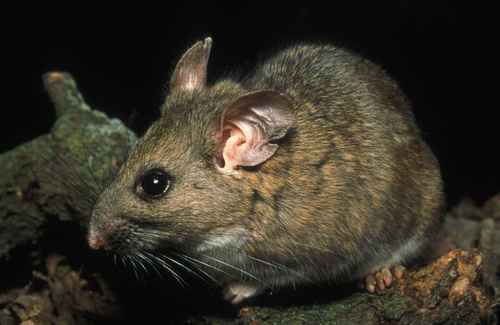
Dusky-footed Woodrat
Neotoma fuscipes
The ultimate architect of the Pacific coast, the Dusky-footed Woodrat is famous for its massive stick houses and its curious habit of 'trading' shiny treasures. These industrious nocturnal rodents offer a fascinating glimpse into a world of complex engineering and woodland community.
Quick Identification
Size
Total length of 33-47 cm (13-18.5 in); Weight typically between 230-450 g (8-16 oz)
Colors
Cinnamon to grayish-brown fur on the back, transitioning to a white or pale cream belly; distinctive dark or 'dusky' fur on the tops of the hind feet.
Key Features
- Large, thinly haired ears and very long whiskers
- Long, hairy tail that is dark on top and light underneath
- Distinctive dusky-colored fur on the tops of the hind feet
- Stocky, rat-like build but with more 'mouselike' facial features
When You’ll See Them
Sightings on EverydayEarth
Jul 9, 2026
A Dusky-footed Woodrat scurries across the rocky foreground under the cover of night. It moves quickly past a large pile of sticks, likely its nest, before disappearing into the shadows of the cliffside.
Geographic range
Where Does the Dusky-footed Woodrat Live?
The Dusky-footed Woodrat is a signature resident of the Pacific coast of North America. Its native range extends from the Willamette Valley in western Oregon southward through the coastal and inland mountain ranges of California, reaching into the northern reaches of Baja California, Mexico. They are most commonly found in the transition zones where dense woodland meets open scrub, thriving in Mediterranean climates with moderate rainfall.
Basemap © OpenStreetMap contributors
Behavior
The Dusky-footed Woodrat is a master architect of the animal kingdom, best known for constructing massive, conical 'houses' out of sticks, bark, and foliage. These structures can reach heights of five feet and are often inherited and expanded over generations. While they are solitary and defensive of their individual homes, they often build in close proximity to one another, creating loosely organized woodland 'neighborhoods.' These woodrats are strictly nocturnal, spending their nights foraging and collecting building materials.
Known popularly as 'packrats' or 'trade rats,' they have a fascinating habit of picking up shiny or interesting objects like jewelry, bottle caps, or silver spoons. If they find a more appealing item while already carrying something, they will frequently drop the original object to pick up the new one, leading to the myth that they are intentionally 'trading' with humans. Despite their name, they are quite clean animals and serve as a vital food source for predators like Spotted Owls and Bobcats.
EverydayEarth exclusive
Camera Tips
To capture the best footage of a Dusky-footed Woodrat, focus your camera on their 'middens' or houses—large conical piles of sticks and debris that can reach several feet in height. Place your camera about 2 to 3 feet off the ground, angled slightly downward toward the base of the house or a well-traveled path leading to it. Woodrats are creatures of habit and will use the same trails repeatedly to transport nesting material and food.
Since these rodents are strictly nocturnal, ensure your camera has high-quality infrared (IR) flash capabilities to avoid scaring them off with white light. Set your trigger speed to the fastest possible setting; while they are busy builders, they can move surprisingly quickly when they sense a predator. A 'Burst Mode' of 3-5 photos or a short 15-second video clip is ideal for capturing them while they are carrying large sticks or 'trading' items.
If you want to encourage a visit to a specific spot, you don't necessarily need food bait. These woodrats are famously attracted to unusual or shiny objects. Placing a few clean bottle caps or small, smooth stones near a known trail might trigger their 'trade' instinct, where they drop what they are carrying to pick up the new treasure, providing a perfect photo opportunity. If using food, a small smear of peanut butter or some acorns can work, but be mindful of attracting larger predators like coyotes or raccoons.
Keep seasonal changes in mind. In late winter and early spring, activity increases as they repair their dens after winter rains and prepare for the breeding season. During these times, you are more likely to see multiple individuals interacting near the larger communal clusters of dens. Check your camera lens frequently, as woodrats are curious and may occasionally sniff or even 'mark' the camera equipment if it’s placed within their immediate territory.
Similar Species
Species that look similar or are commonly confused with Dusky-footed Woodrat.
Frequently Asked Questions
Record Dusky-footed Woodrat at your habitat
Connect a camera to start building your own species record — AI identifies every visitor automatically.