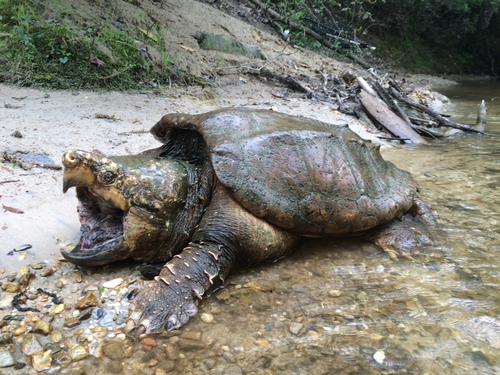
Alligator Snapping Turtle
Macrochelys temminckii
The Alligator Snapping Turtle is North America's largest freshwater turtle, a prehistoric giant that uses a built-in fishing lure to survive in the deep bayous of the South.
Quick Identification
Size
Carapace length 16–32 inches (40–80 cm); weight typically 80–250 lbs (35–115 kg), though record specimens have exceeded 220 lbs (100 kg).
Colors
Dark brown, black, or olive-gray carapace often covered in green algae; skin is typically gray or brown with yellowish patterns on the head.
Key Features
- Three prominent longitudinal ridges (keels) on the shell
- Massive head with a powerful, hooked, hawk-like beak
- Small, worm-like pink lure located on the floor of the mouth
When You’ll See Them
Geographic range
Where Does the Alligator Snapping Turtle Live?
Native to the North American continent, the alligator snapping turtle is found exclusively in the United States. Its core range is concentrated in the river systems that drain into the Gulf of Mexico, extending from the Florida Panhandle and southwestern Georgia through the Gulf states to eastern Texas. This species also reaches far inland, following the Mississippi River Valley northward into Missouri, southern Illinois, and southeastern Iowa. Because they are highly aquatic, their presence is strictly tied to major freshwater watersheds and their associated tributaries.
Basemap © OpenStreetMap contributors
Behavior
The alligator snapping turtle is often described as the 'dinosaur of the turtle world' due to its prehistoric appearance and sedentary lifestyle. Unlike the common snapping turtle, which is more active and prone to aggression on land, the alligator snapper is a master of patience. It spends the vast majority of its life submerged in deep water, often lying perfectly still on the muddy bottom or among sunken logs. It is so stationary that algae frequently grow on its shell, providing nearly perfect camouflage against the riverbed.
These turtles are famous for their unique hunting technique. By opening their mouths and wiggling a fleshy, worm-shaped appendage on their tongue, they lure unsuspecting fish directly into their jaws. While they are primarily solitary and nocturnal, they may be seen during the day basking in shallow water or, in the case of nesting females, venturing onto land to lay eggs. Although they have a fearsome reputation, they are generally docile in the water and only strike when directly threatened or while hunting.
EverydayEarth exclusive
Camera Tips
Capturing an alligator snapping turtle on camera requires a focus on aquatic or semi-aquatic environments. If you are using a standard backyard trail camera, place it on a sturdy stake or tree trunk facing a muddy bank or a shallow shoreline where turtles might emerge to bask or nest. The best angle is slightly downward, about 1-2 feet off the ground, to capture the detail of the shell's ridges. Because they are primarily nocturnal, ensure your camera has a high-quality infrared flash that won't spook the animal or reflect too harshly off the water's surface.
To attract them to a specific spot, you can use scent-based lures. A common trick among researchers is to use a securely perforated can of oily fish, like sardines or mackerel, anchored in shallow water near the camera. The scent trail will travel through the water and may draw a hungry snapper into the frame. Be sure to place the bait in a way that forces the turtle to present its side or head toward the lens for a clear identification photo.
If you are feeling adventurous and have a waterproof housing, setting up a camera submerged near a submerged log or 'snag' can yield incredible results. Look for slow-moving sections of rivers or bayous with high clarity. Since these turtles can stay underwater for 40-50 minutes at a time, time-lapse mode or a high-sensitivity motion sensor is essential. Late spring and early summer are the best times for bank-side sightings, as this is when females travel inland to find nesting sites.
Similar Species
Species that look similar or are commonly confused with Alligator Snapping Turtle.
Frequently Asked Questions
Record Alligator Snapping Turtle at your habitat
Connect a camera to start building your own species record — AI identifies every visitor automatically.