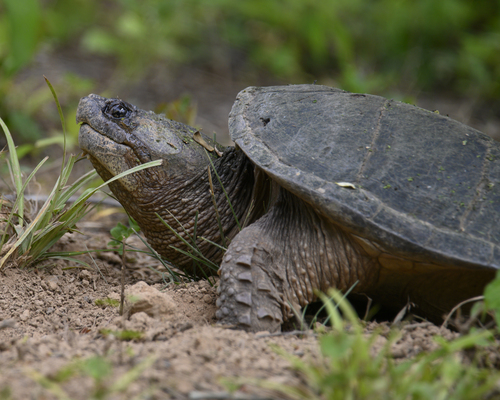
Common Snapping Turtle
Chelydra serpentina
Meet the prehistoric survivor of North America's waterways. With its rugged shell and powerful jaws, the Common Snapping Turtle is a fascinating glimpse into the age of reptiles.
Quick Identification
Size
Shell length 20–47 cm (8–18.5 in); weight 4.5–16 kg (10–35 lbs), with some reaching up to 34 kg (75 lbs).
Colors
Upper shell (carapace) is dull brown, tan, or olive-gray with dark markings; skin is yellowish or gray; plastron is a small, yellow-tan cross shape.
Key Features
- Large, heavy head with a hooked beak
- Long, saw-toothed tail with three rows of bony scales
- Small, cross-shaped plastron that leaves most of the underbody exposed
- Highly mobile neck that can reach significantly far back
When You’ll See Them
Geographic range
Where Does the Common Snapping Turtle Live?
Common Snapping Turtles are native to the North American continent, holding a massive territory that stretches from the Atlantic coast in the east to the foothills of the Rocky Mountains in the west. Their core range begins in southeastern Canada, moving through the Great Lakes region and down across the entire eastern United States into Florida. While they thrive in the humid temperate zones of the Northeast, they have also successfully established themselves in the arid Middle Rio Grande drainage of New Mexico, proving their status as one of the most adaptable reptiles in the Western Hemisphere.
Basemap © OpenStreetMap contributors
Behavior
Common Snapping Turtles are primarily aquatic and surprisingly shy when in the water. They spend much of their time lying in wait on muddy bottoms or cruising slowly through aquatic vegetation in search of prey. Unlike many other turtles, they rarely bask on logs out of the water, preferring to float at the surface with only their eyes and nostrils exposed. When they do emerge onto land—typically for nesting or moving between ponds—their behavior shifts; lacking the ability to fully retract into their shells for protection, they adopt a defensive 'snapping' posture to deter potential predators.
These reptiles are solitary creatures and highly opportunistic feeders. They play a vital role in their ecosystems as both predators and scavengers, helping to keep waterways clean by consuming carrion. While they have a reputation for being aggressive, they generally avoid human contact unless cornered on land. In a backyard setting with a pond, they are quiet neighbors that might go unnoticed for years despite their impressive size.
EverydayEarth exclusive
Camera Tips
Capturing the Common Snapping Turtle on a backyard camera requires a low-profile approach. Because they spend most of their time in the water, place your camera at the edge of a pond or marsh on a mudflat. Mount the camera just 6 to 12 inches off the ground and angle it slightly downward. This perspective captures their unique, prehistoric facial features and the rugged texture of their shells that often gets lost from a higher angle.
If you have a backyard pond, look for partially submerged logs or shallow 'shelves' in the water. While they don't bask as frequently as Painted Turtles, they will often sit in shallow water with just their heads poking out. Using a camera with a fast trigger speed is essential; while the turtle itself moves slowly, their neck can strike with incredible velocity when they are hunting or defending themselves.
Scent is the best lure for this species. A small mesh bag or a perforated tin of sardines or tuna in oil can be staked into the mud directly in front of the camera. The intense smell will draw the turtle in and keep it stationary while it investigates, allowing for excellent close-up footage. Be sure to secure the lure firmly, as a large snapper can easily drag away unsecured bait.
The best time for land-based 'backyard' sightings is late May through June. This is when females travel away from the water to find sandy soil or garden mulch to lay their eggs. During this window, place cameras near flower beds or transition areas between your lawn and the nearest water source. Set your camera to a video mode of at least 30 seconds to capture the fascinating process of them navigating terrain or digging.
Similar Species
Species that look similar or are commonly confused with Common Snapping Turtle.
Frequently Asked Questions
Record Common Snapping Turtle at your habitat
Connect a camera to start building your own species record — AI identifies every visitor automatically.