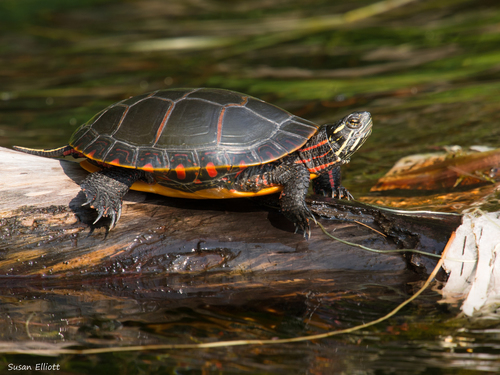
Painted Turtle
Chrysemys picta
Meet the most colorful and widespread turtle in North America. Known for their intricate red and yellow patterns and their love of long afternoon sunbaths, the Painted Turtle is a vibrant addition to any backyard pond or local wetland.
Quick Identification
Size
Shell length of 10-25 cm (4-10 inches); females are typically larger than males.
Colors
Dark olive to black carapace (upper shell) with red or yellow markings on the edges; yellow and red stripes on the neck, head, and limbs; yellow plastron (bottom shell).
Key Features
- Smooth, dark carapace with red and yellow patterns along the rim
- Bright yellow stripes on the head and neck
- Yellow plastron (bottom shell) often featuring a dark central pattern
- Webbed feet adapted for aquatic life
When You’ll See Them
Sightings on EverydayEarth
Jun 1, 2026
A Painted Turtle is seen crawling slowly across a patch of grass and dry leaves. It moves steadily forward, with bits of green duckweed or algae visible on its dark shell, suggesting it recently emerged from a nearby water source.
May 27, 2026
A large group of Painted Turtles is basking on a long, floating log in the water. The turtles are mostly stationary, soaking up the afternoon sun, though one individual near the center of the log crawls over its neighbors to adjust its position.
May 24, 2026
A long line of Painted Turtles is basking on a partially submerged log in a pond. Several turtles are seen stretching their hind legs out behind them to maximize sun exposure, a behavior known as basking. The water around the log is still, with some aquatic vegetation visible.
May 24, 2026
A long line of Painted Turtles is perched along a semi-submerged log, basking in the afternoon sun. Several individuals are seen stretching their necks and limbs to maximize sun exposure while others remain still.
May 21, 2026
A group of Painted Turtles is basking in the bright sunlight among the reeds and aquatic vegetation of a marshy wetland.
May 21, 2026
A Canada Goose stands on a log positioned over the water, turning its head to preen its feathers. Further down the same log, three turtles are huddled together basking in the bright sunlight. The water is calm and clearly reflects the blue sky and white clouds above.
Behavior
Painted Turtles are the quintessential sun-seekers of North American wetlands. They spend a vast majority of their daylight hours basking on logs, rocks, or any floating debris that allows them to soak up UV rays. This isn't just for leisure; as cold-blooded animals, they rely on the sun to regulate their body temperature and jumpstart their metabolism for digestion. You will often see them stacked on top of each other in a practice called 'communal basking,' vying for the best spot in the sun.
While they are social when basking, Painted Turtles are quite shy and wary of movement. At the slightest hint of a predator or a curious human, they will tuck their heads and slide silently into the water. They are excellent swimmers and spend their nights sleeping on the pond floor or resting among aquatic vegetation. During the winter, they enter a state of brumation, burying themselves in the mud where they can survive for months without taking a single breath of air.
EverydayEarth exclusive
Camera Tips
Capturing the perfect shot of a Painted Turtle requires a strategy focused on their 'basking' routine. Because these turtles return to the same logs or rocks every sunny day, predictability is your best friend. Position your camera on the bank or a low-profile dock, aiming it directly at a prominent log that protrudes from the water. Use a mounting arm to get the camera as close to the water level as possible—an eye-level shot creates a much more engaging and intimate portrait than a high-angle shot looking down from a high bank.
A major challenge with turtles is that standard trail cameras use PIR (Passive Infrared) sensors that detect heat and motion. Since a basking turtle’s body temperature eventually matches the sun-warmed log it is sitting on, the camera may fail to trigger. To solve this, switch your camera to 'Time Lapse' mode. Set the interval to take a photo every 5 to 10 minutes during the peak sun hours of 10 AM to 3 PM. This ensures you capture them while they are stationary, even if the motion sensor doesn't 'see' them.
If you are setting up in a backyard pond, you can actually create a dedicated 'photo stage' by placing an attractive log in a clear, sunny spot within the camera's field of view. Ensure the log is stable and easy for a turtle to climb. In late spring (May and June), keep an eye on land; females often leave the water to find nesting sites in sandy or loamy soil. Placing a camera low to the ground near the water’s edge during this time can catch rare footage of them on the move.
Lastly, pay attention to lens maintenance. Humidity near water can cause fogging, and splashing can leave water spots on the lens. Check your camera regularly and use a rain shield or a small overhang if possible to keep the lens clear. If your camera allows for focal adjustments, set it for about 3-5 feet to ensure the basking spot is in crisp focus while the background remains softly blurred.
Similar Species
Species that look similar or are commonly confused with Painted Turtle.
Frequently Asked Questions
Record Painted Turtle at your habitat
Connect a camera to start building your own species record — AI identifies every visitor automatically.