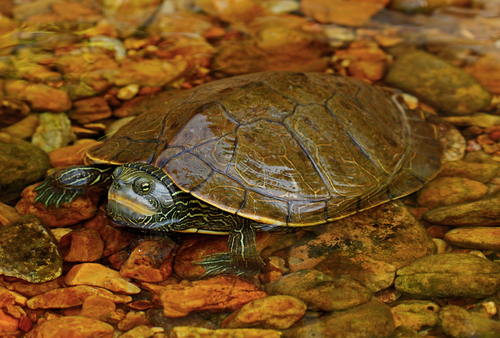
Northern Map Turtle
Graptemys geographica
Often called the 'topographic turtle,' this master of the river is draped in a stunning pattern of golden map-like lines. A true sight for the patient observer, they are the most elusive sun-baskers of the turtle world.
Quick Identification
Size
Females range from 7-11 inches (18-27 cm); males are much smaller, typically 3.5-6.5 inches (9-16 cm).
Colors
Olive green to grayish-brown shell with intricate yellow-orange lines; yellow stripes on the skin and a distinct small yellow spot behind the eye.
Key Features
- Golden-yellow contour lines on carapace resembling a topographic map
- Small, isolated yellow spot behind the eye
- Strongly keeled shell with a serrated or 'toothed' rear edge
- Massive head in adult females used for crushing shells
When You’ll See Them
Behavior
The Northern Map Turtle is famously shy and wary of its surroundings. It is a highly aquatic species that spends the vast majority of its time in the water or basking on emergent logs and rocks. At the slightest hint of danger or the sound of an approaching human, these turtles will slide instantly into the water and remain submerged for long periods.
Because they are communal baskers, you will often see them stacked or crowded onto a single log to soak up UV rays. Unlike some bolder species, Northern Map Turtles do not handle interaction well and are best observed from a distance. They are quite social with other turtles but maintain a high level of vigilance, often acting as the 'sentinels' that alert other turtles to dive when a predator approaches.
EverydayEarth exclusive
Camera Tips
To capture the Northern Map Turtle, your camera placement must focus on 'basking real estate.' Identify a log or rock that remains above water even during high tide or heavy rain. Mount your camera on a nearby stable object—like a tree trunk or a post driven into the bank—about 3 to 5 feet above the water level. Angle the camera downward at a 45-degree angle toward the basking site. Because these turtles are so skittish, setting up the camera should be done quickly to minimize your presence in their habitat.
Glare is the enemy of aquatic photography. If possible, position your camera facing North or South to avoid the direct East-West path of the sun, which can cause 'white-out' reflections off the water. If your AI camera allows for motion zones, exclude the moving water around the log and focus the trigger area specifically on the wood surface where the turtles climb up. This prevents hundreds of 'false' videos caused by ripples or floating debris.
During the nesting season in late spring and early summer, females will leave the water to find sandy or loamy soil. If your backyard borders a river or lake, place a second camera low to the ground—no more than 12 inches high—facing a clearing or a sandy patch. Use a high-sensitivity setting or a time-lapse mode (one photo every 5-10 minutes) to catch their slow overland progress, as their movement is often too deliberate to trigger some standard PIR sensors quickly.
Similar Species
Species that look similar or are commonly confused with Northern Map Turtle.
Frequently Asked Questions
Record Northern Map Turtle at your habitat
Connect a camera to start building your own species record — AI identifies every visitor automatically.