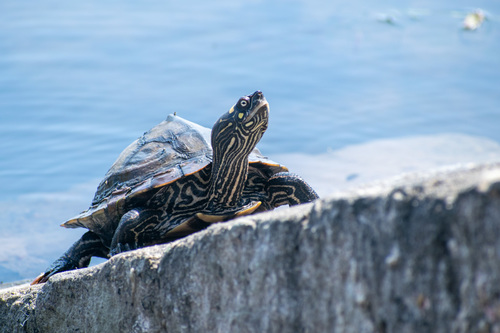
Ouachita Map Turtle
Graptemys ouachitensis
Defined by the intricate 'topographical' lines on its shell and a jagged, saw-like ridge along its spine, the Ouachita Map Turtle is a masterpiece of river evolution. These 'sawbacks' are the shyest residents of the waterway, requiring a patient eye and a well-placed camera to witness their sun-drenched daily rituals.
Quick Identification
Size
Males reach 3.5 to 5 inches (9-13 cm); larger females reach 5 to 10.75 inches (13-27 cm).
Colors
Olive to grayish-brown carapace with yellow or tan lines resembling a map; head and limbs are dark with bright yellow stripes and distinct yellow spots.
Key Features
- Three prominent yellow spots on the side of the head (behind the eye, under the eye, and on the jaw)
- Strongly serrated 'sawback' ridge or keel along the center of the shell
- Intricate yellow 'topographical map' markings on the carapace
- Large, webbed hind feet for powerful swimming.
When You’ll See Them
Behavior
The Ouachita Map Turtle is a highly aquatic species known for its extremely shy and wary nature. Unlike more bold pond turtles, map turtles are notoriously skittish; they spend hours basking on logs or rocks to regulate their body temperature, but will plunge into the water at the slightest vibration or distant movement. They are strong swimmers, perfectly adapted for moving through the currents of river systems and large lakes.
Socially, they are often seen basking in groups, sometimes stacking on top of one another to secure the best position in the sun. They do not have a significant interaction with humans and generally avoid any area with high boat traffic or human shoreline activity. In the winter, they brumate (hibernate) underwater, often wedging themselves into submerged debris or burying into the mud at the bottom of deep pools where the water does not freeze solid.
EverydayEarth exclusive
Camera Tips
To capture high-quality footage of a Ouachita Map Turtle, your camera placement must account for their extreme shyness. The best location is overlooking a preferred basking site, such as a partially submerged log or a flat rock that receives direct sunlight for several hours. Mount your camera on a nearby tree or a sturdy stake driven into the bank, roughly 10 to 15 feet away. Because these turtles have excellent eyesight, use a camera with a matte or camo finish to prevent lens flare from scaring them off before they even climb out of the water.
Position the camera at a low angle, about 1 to 2 feet above the water line. This provides a profile view of the turtle’s 'sawback' keel and head markings, which are essential for identification. If your camera has a zoom lens or a high-resolution sensor, use it to frame the basking spot tightly. Avoid pointing the camera directly East or West to prevent harsh glare from the water's surface, which can wash out the intricate patterns on the turtle's shell.
Since map turtles spend a lot of time stationary while basking, standard motion triggers can sometimes be unreliable or produce thousands of 'empty' frames if the water is choppy. Use a 'Hybrid Mode' if available—combining motion detection with a time-lapse interval (e.g., one photo every 5-10 minutes). This ensures you catch them even if they are resting perfectly still. High-sensitivity settings are recommended for the motion trigger to detect the slow, deliberate movement of a turtle emerging from the river.
While baiting is rarely effective for map turtles in the traditional sense, you can 'engineer' a prime basking spot to attract them. If your shoreline lacks logs, anchoring a sturdy piece of driftwood in a sunny, quiet area can draw them in. Ensure the log has a gentle slope so they can easily crawl up. Early summer is the peak time for activity, especially in the mornings as they seek warmth after a cool night in the water.
Similar Species
Species that look similar or are commonly confused with Ouachita Map Turtle.
Frequently Asked Questions
Record Ouachita Map Turtle at your habitat
Connect a camera to start building your own species record — AI identifies every visitor automatically.