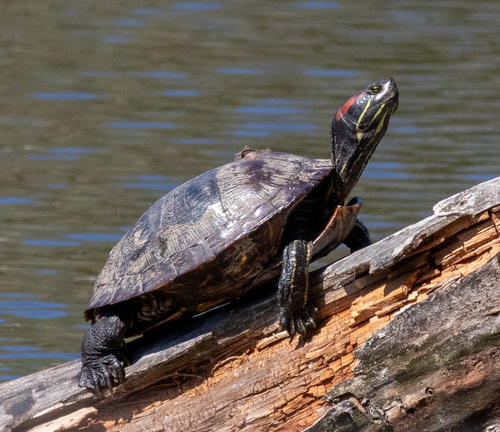
Pond Slider
Trachemys scripta
The Pond Slider is the most iconic freshwater turtle in the Americas, famous for its love of sunshine and its lightning-fast retreats into the water. Whether it's the famous Red-eared Slider or its yellow-striped cousins, these resilient reptiles are a joy to observe in any backyard water feature.
Quick Identification
Size
Carapace length of 5-11 inches (12-28 cm); weight typically ranges from 1-3 lbs (0.5-1.4 kg)
Colors
Olive to brown shell; yellow plastron with dark spots; green skin with yellow stripes; Red-eared subspecies has a distinct red patch behind the eye
Key Features
- Oval, streamlined carapace with a slight central ridge
- Distinctive yellow or red 'ear' stripes on the sides of the head
- Long, narrow front claws on mature males
- Yellow-to-orange underside (plastron) often marked with dark blotches
When You’ll See Them
Behavior
Pond Sliders are the ultimate sun-seekers of the reptile world. You will most often spot them 'stacked' on top of one another on partially submerged logs or rocks, a behavior known as basking. This isn't just for relaxation; they are cold-blooded and rely on the sun's UV rays to regulate their body temperature and aid in the digestion of their food. They are incredibly wary and earned their name 'slider' from their habit of quickly sliding off their basking spots and into the safety of the water at the slightest hint of danger.
While they spend the majority of their lives in the water, females will venture onto land during the late spring and early summer to find suitable nesting sites. They are generally solitary creatures but are highly social in the sense that they tolerate the presence of many other turtles in high-quality basking areas. In a backyard setting with a pond, they can become quite accustomed to a regular human presence, though they will usually remain in the water where they feel most secure.
EverydayEarth exclusive
Camera Tips
To capture the best footage of a Pond Slider, your camera placement should focus exclusively on their 'exit and entry' points. Look for partially submerged logs, flat rocks, or even low-hanging branches that touch the water. Position your AI-powered camera 12-18 inches above the water level, angled slightly downward toward the basking spot. Because these turtles are highly sensitive to movement, a camera with a silent shutter or a remote trigger is essential to prevent them from diving before the shot is taken.
Lighting is your best friend when photographing sliders. Because they are most active during the brightest parts of the day, harsh glare off the water can blow out your highlights. If your camera settings allow, slightly underexpose the shot to preserve the detail in their yellow stripes and shell patterns. For the most engaging 'action' shots, set your camera to a time-lapse mode with 5-minute intervals near a known basking log. This captures the slow movement of turtles climbing out of the water, which often occurs too slowly to trigger some motion sensors effectively.
If you are trying to capture them in a backyard pond, consider the 'eye-level' perspective. Placing the camera as low to the ground as possible creates a much more intimate and professional look than a high-angle security camera view. During the nesting season (May through July), you might also place a camera near loose, sandy soil within 100 yards of the water, as this is where females will likely be searching for a place to bury their eggs. Just be sure to use a waterproof housing, as pond-side environments are prone to heavy dew and splashes.
Similar Species
Species that look similar or are commonly confused with Pond Slider.
Frequently Asked Questions
Record Pond Slider at your habitat
Connect a camera to start building your own species record — AI identifies every visitor automatically.