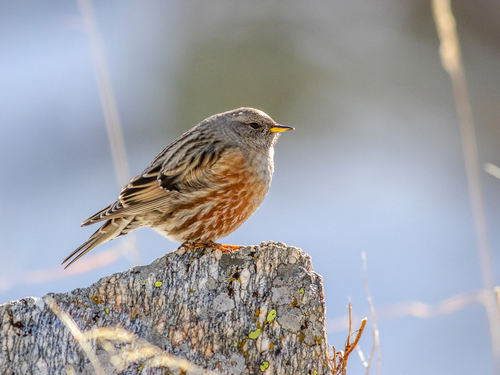
Alpine Accentor
Prunella collaris
A hardy specialist of the high peaks, the Alpine Accentor thrives where few other birds dare to go. Known for its 'tame' personality and beautifully intricate plumage, it is the crown jewel of mountain wildlife photography.
Quick Identification
Size
Length: 15–18 cm (6–7 in); Wingspan: 30–35 cm (12–14 in); Weight: 25–40 g (0.9–1.4 oz)
Colors
Lead-grey head and breast, white throat with black spots, rufous-streaked flanks, and dark brown wings with white-tipped coverts. Sexes are similar, though males may be slightly brighter.
Key Features
- Distinctive white throat with black speckling (the 'collar')
- Yellow base to the lower mandible
- Rich rufous or orange-brown streaks along the belly and flanks
- Large, robust build for an accentor
When You’ll See Them
Geographic range
Where Does the Alpine Accentor Live?
Native to the towering mountain ranges across the Palearctic, the Alpine Accentor is a true high-altitude specialist. Its range begins in the west with the Atlas Mountains of North Africa and the Sierra Nevada and Pyrenees of the Iberian Peninsula, stretching across the European Alps, the Balkans, and the Caucasus. Further east, the species follows the rugged terrain of the Himalayas and the Tibetan Plateau, extending into central China and as far as the mountain peaks of Japan. While they are generally non-migratory in the traditional sense, they are famous for their vertical journeys, descending into lower valleys and villages only when heavy snow blankets their high-elevation breeding grounds.
Basemap © OpenStreetMap contributors
Behavior
The Alpine Accentor is renowned for its remarkable lack of fear toward humans, often hopping around the feet of hikers and skiers at high-altitude resorts. Unlike many mountain species that remain elusive, this bird is social and inquisitive. During the breeding season, they live in complex social groups where several males and females share territories, a rare polyandrous mating system that ensures maximum chick survival in harsh environments.
On the ground, they move with a characteristic creeping or hopping motion, constantly flicking their wings while searching for food among rocks and low vegetation. While they are capable of strong flight, they spend the vast majority of their time on the earth or perched on crags. In the winter, they exhibit altitudinal migration, moving down from the highest peaks to mountain villages and ski stations to find easier forage.
EverydayEarth exclusive
Camera Tips
To capture high-quality footage of an Alpine Accentor, your camera should be placed at ground level. These birds are almost exclusively terrestrial foragers. Position your AI-powered camera on a flat rock or a patch of low-growing alpine turf where there is clear visibility. If you are setting up near a mountain hut or ski resort during winter, look for areas where snow has been cleared or where birds have been seen scavenging. A low angle—about 4 to 6 inches off the ground—will yield the most intimate, professional-looking portraits of this species.
Since Alpine Accentors are relatively small and move with quick, jerky hops, use a fast trigger speed (0.2 seconds or less) to avoid blurry images. If your camera allows, set it to take a short burst of photos or a 10-second video clip upon motion detection. Because alpine light can be incredibly harsh due to snow reflection and thin atmosphere, try to position the camera so the sun is at its back, or in a slightly shaded area to avoid 'blown-out' whites on the bird's throat and belly.
In the winter months, you can successfully lure them into your camera's frame using small bird seeds or finely crushed suet. They are particularly fond of high-fat foods that provide energy for the cold. During the summer, look for 'snow patches' that are melting; these areas often trap insects and serve as natural magnets for foraging accentors. Ensure your camera is rugged and weather-sealed, as mountain weather can change from sun to blizzard in minutes.
Similar Species
Species that look similar or are commonly confused with Alpine Accentor.
Frequently Asked Questions
Record Alpine Accentor at your habitat
Connect a camera to start building your own species record — AI identifies every visitor automatically.