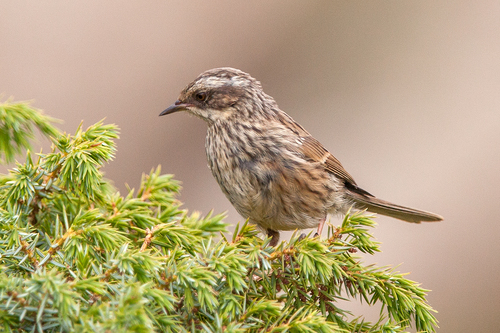
Radde's Accentor
Prunella ocularis
A resilient specialist of the high peaks, Radde's Accentor is a master of the rocky slopes. With its striking white eyebrow and hardy nature, this small bird thrives in the most rugged landscapes of Southwest Asia.
Quick Identification
Size
14.5–16 cm (5.7–6.3 in) in length; 22–25 cm (8.6–9.8 in) wingspan; weight 20–25 g (0.7–0.9 oz)
Colors
Distinctive white eyebrow (supercilium), blackish-brown crown and cheek mask, creamy throat, and brown-streaked back. Male and female appear similar.
Key Features
- Bold white stripe above the eye
- Blackish face mask and crown
- Fine, pointed bill for insect eating
- Streaked brown upperparts with pale underparts
When You’ll See Them
Geographic range
Where Does the Radde's Accentor Live?
Radde's Accentor is native to the rugged highlands of Southwest Asia and the Arabian Peninsula, flourishing in some of the region's most dramatic mountain ranges. Its core range extends across the peaks of Turkey, Iran, Armenia, Georgia, and Azerbaijan, reaching southward into Lebanon and northern Iraq. A distinct and isolated population also resides in the high-altitude mountains of Yemen, making this species a fascinating link between Middle Eastern and Arabian montane wildlife.
Basemap © OpenStreetMap contributors
Behavior
Radde's Accentor is a hardy, ground-dwelling bird of the high mountains. It is known for its somewhat secretive or 'skulking' behavior, often staying close to the cover of boulders and low-growing alpine scrub. Despite this shy nature, males can be quite conspicuous during the breeding season when they sing from prominent rock perches to defend their territories.
These birds move with a deliberate, creeping hop while foraging, often flicking their wings in a manner typical of the accentor family. While they are usually seen in pairs or small family groups during the summer, they may form loose, nomadic flocks in the winter when they descend to slightly lower elevations to escape the harshest mountain weather. They are rarely found far from rocky terrain.
EverydayEarth exclusive
Camera Tips
To successfully capture Radde's Accentor on a trail camera, placement is everything. Because these birds spend the majority of their time on the ground, your camera should be mounted very low—ideally between 6 and 12 inches off the ground. Aim the lens across a flat rock or a clearing between alpine bushes where the birds are likely to forage. Using a wide-angle lens setting can help capture their movement as they hop between boulders.
In the arid mountain environments where they live, water is a powerful lure. If you can locate a small mountain seep, a melting snow patch, or even a natural rock depression that holds rainwater, position your camera there. They frequently visit these spots to drink and bathe. If you are setting up in a high-altitude backyard, a ground-level stone birdbath that mimics a natural puddle will be much more effective than a hanging bird feeder.
Since Radde's Accentors are active in the crisp morning air, ensure your camera has a fast trigger speed and high-quality low-light sensors to handle the shadows of deep mountain valleys. During the winter months, if you are located in their lower-elevation wintering grounds, placing a tray of fine seeds like millet or nyjer near rocky cover can encourage them to linger in front of the lens. Always camouflage your camera with local rocks or vegetation, as these birds can be wary of new objects in their territory.
Similar Species
Species that look similar or are commonly confused with Radde's Accentor.
Frequently Asked Questions
Record Radde's Accentor at your habitat
Connect a camera to start building your own species record — AI identifies every visitor automatically.