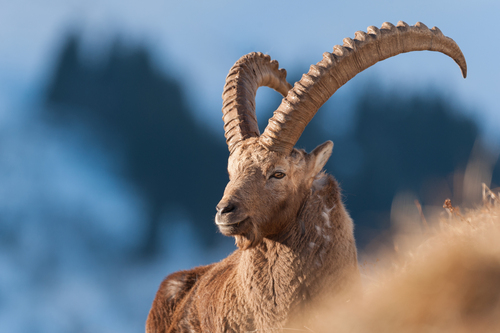
Alpine Ibex
Capra ibex
The legendary 'King of the Alps,' the Alpine ibex is a gravity-defying climber that rules the highest peaks of Europe. With massive curved horns and incredible agility, they turn near-vertical cliffs into their personal playground.
Quick Identification
Size
Body length of 115-170 cm (45-67 in); shoulder height of 70-105 cm (28-41 in); weight 70-120 kg (150-260 lbs) for males, 17-65 kg (37-143 lbs) for females.
Colors
Brownish-grey coat that turns a darker, richer brown in summer and a lighter, thicker grey in winter; pale underbelly.
Key Features
- Massive scimitar-shaped horns reaching up to 1m in males
- Distinctive goatee beard on adult males
- Large, robust build with thick, muscular necks
- Specialized hooves with a hard outer edge and soft, grippy inner pads
When You’ll See Them
Geographic range
Where Does the Alpine Ibex Live?
The Alpine ibex is a quintessential mountain dweller native to the European Alps, forming a jagged arc across the center of the continent. Their core populations thrive in the high-altitude regions of Switzerland, Italy, France, and Austria, with smaller established groups in Germany and Slovenia. While they were once pushed to the brink of extinction, successful reintroduction programs have ensured their return to nearly every major massif within their historical alpine range.
Basemap © OpenStreetMap contributors
Behavior
The Alpine ibex is a master of the vertical world, spending its days navigating near-vertical rock faces and high alpine meadows. They are highly social but generally live in sex-segregated herds for most of the year. Adult males form bachelor groups, while females and their young stay together in nursery herds. They only mix during the winter rut, when males engage in dramatic, clashing head-butts to establish dominance and breeding rights.
These goats are diurnal, beginning their day at sunrise to graze on steep slopes before retreating to higher, inaccessible cliffs during the midday heat to rest and ruminate. They are surprisingly calm around humans in protected national parks, often allowing hikers to observe them from a distance, though they remain wary of sudden movements or predators like wolves and golden eagles.
EverydayEarth exclusive
Camera Tips
Capturing the Alpine ibex requires a different approach than typical backyard wildlife. Because they inhabit steep, rocky terrain, your camera should be positioned on known 'highways'—the narrow ledges and passes they use to move between grazing slopes and sleeping cliffs. Aim for a 45-degree angle across the path rather than a head-on shot to capture the full profile of their impressive horns and muscular build.
Salt is a massive draw for this species. In many parts of the Alps, ibex are famous for licking minerals off dam walls or natural salt deposits. If legal in your region, placing a salt lick in a safe, rocky clearing can provide consistent, high-quality footage. Ensure your camera is secured with a steel security box and cable lock, as the harsh mountain wind and curious rams can easily displace a loosely mounted device.
Since light changes rapidly in the mountains, use a camera with a high dynamic range to avoid 'blowing out' the details of their coat against bright snow or dark rocks. Set your trigger speed to the fastest possible setting; while they look slow while grazing, they can leap across a frame in a fraction of a second when moving between ledges. Consider a wide-angle lens to capture the dramatic mountain backdrop, which adds significant context and value to your captures.
Similar Species
Species that look similar or are commonly confused with Alpine Ibex.
Frequently Asked Questions
Record Alpine Ibex at your habitat
Connect a camera to start building your own species record — AI identifies every visitor automatically.