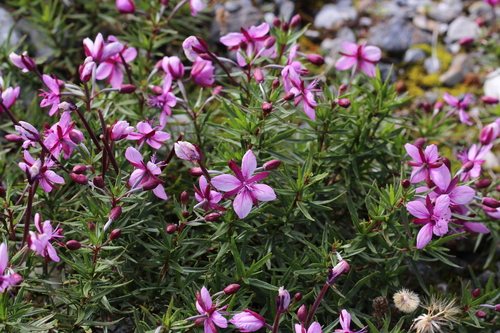
alpine willowherb
Chamaenerion fleischeri
A resilient survivor of the high peaks, the Alpine willowherb transforms harsh glacial gravel into a sea of magenta. This hardy pioneer is a vital first step in mountain life, stabilizing the very ground it grows on.
Quick Identification
Size
10 to 40 cm (4 to 16 inches) in height; flowers measure 2 to 3 cm (0.8 to 1.2 inches) in diameter.
Colors
Vibrant pink to magenta petals, reddish-purple stems, and glaucous (bluish-green) foliage.
Key Features
- Bright pink four-petaled flowers with prominent stamens
- Narrow, linear bluish-green leaves
- Clump-forming growth habit on rocky terrain
- Elongated, reddish seed capsules that release fluffy white seeds
When You’ll See Them
Geographic range
Where Does the alpine willowherb Live?
The Alpine willowherb is a specialist of the high-altitude landscapes of Central Europe, predominantly found throughout the vast arc of the Alps. It is native to the mountainous regions of Switzerland, France, Italy, Austria, and Germany, where it follows the paths of glacial retreat and alpine streams. While its heartland is the alpine chain, scattered populations also exist in the Jura Mountains and parts of the Carpathians, always favoring cool, rocky environments where competition from taller plants is minimal.
Basemap © OpenStreetMap contributors
Behavior
The Alpine willowherb is a classic pioneer species, specifically adapted to colonize 'new' land left behind by retreating glaciers or shifting mountain rivers. Unlike many garden plants, it thrives in unstable environments like moraines and scree slopes. It uses a vigorous system of creeping rhizomes to anchor itself into loose gravel, helping to stabilize the soil for future plant succession.
During the short alpine growing season, this plant works at a rapid pace. It blooms from June to August, attracting a variety of high-altitude pollinators including hoverflies and specialized mountain bees. Once the flowers are spent, the plant produces long, narrow pods that eventually burst open, releasing seeds attached to silky umbrellas of hair that allow them to be carried kilometers away by mountain thermals.
EverydayEarth exclusive
Camera Tips
To successfully capture the Alpine willowherb on a trail camera, you must consider its low stature. These plants rarely grow taller than 40 centimeters, so mounting your camera on a standard tree strap will likely overshoot the subject. Instead, use a ground-level stake or a small, weighted tripod. Aiming the lens slightly upward from a low angle not only captures the underside of the delicate pink petals but also allows you to frame the plant against the dramatic mountain sky, creating a much more compelling composition than a top-down view.
If your camera supports time-lapse mode, the Alpine willowherb is an exceptional subject. Set the interval to one photo every 20 minutes during the peak flowering months of July and August. This will allow you to see the flowers track the sun and, eventually, the spectacular 'explosion' of the seed pods as they release their white, cotton-like fluff. Because mountain weather is notoriously windy, try to select a cluster of plants that are somewhat sheltered by a large boulder to minimize motion blur in your images.
Lighting is your best friend with this species. The bluish-green leaves and magenta petals are most vibrant during the 'golden hours' of early morning and late afternoon. However, because these plants are heliophilous (sun-loving), the flowers are most likely to be fully open during mid-day. If your camera allows for exposure adjustment, slightly underexposing can help preserve the deep pink saturation of the petals which can otherwise look 'washed out' in the intense high-altitude sunlight.
Similar Species
Species that look similar or are commonly confused with alpine willowherb.
Frequently Asked Questions
Record alpine willowherb at your habitat
Connect a camera to start building your own species record — AI identifies every visitor automatically.