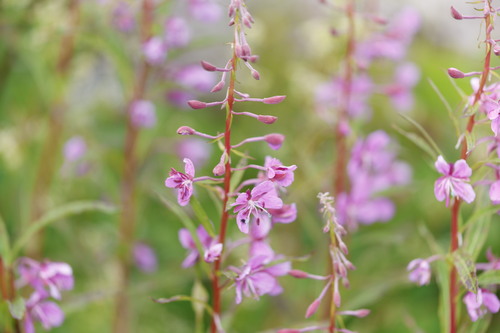
fireweed
Chamaenerion angustifolium
A spectacular herald of summer, Fireweed transforms disturbed landscapes into seas of brilliant magenta. This hardy wildflower is a favorite of pollinators and a symbol of nature's ability to regenerate after fire.
Quick Identification
Size
Typically grows 0.5 to 2.5 meters (1.5 to 8 feet) tall with a spread of about 1 meter (3 feet).
Colors
Brilliant pink to magenta flowers; green lance-shaped leaves with a distinctive white central vein; reddish stems.
Key Features
- Tall, unbranched stems topped with a spike of four-petaled pink flowers
- Leaves are narrow and alternate with a unique circular vein pattern
- Long, narrow seed pods that split to release fluffy, white wind-dispersed seeds
- Produces a 'fire-like' display when massed together in late summer
When You’ll See Them
Behavior
Fireweed is a resilient pioneer species, often being the first plant to colonize areas scorched by wildfire or disturbed by human activity. It spreads aggressively through an underground network of rhizomes and produces massive quantities of wind-borne seeds, allowing it to dominate landscapes quickly. In a backyard or woodland edge setting, it acts as a vibrant focal point that signals the height of summer.
Ecologically, fireweed is a powerhouse. It is a primary nectar source for a wide variety of pollinators, including honeybees, bumblebees, and various butterflies. In northern regions, it is a critical food source for hummingbirds. While it doesn't 'behave' in the animal sense, its growth cycle is a dramatic transformation from a leafy green stalk to a towering spire of magenta, eventually turning into a cloud of white fluff by autumn.
EverydayEarth exclusive
Camera Tips
To capture the best images of fireweed with an AI-powered backyard camera, position your device at a mid-height level, roughly 3 to 4 feet off the ground. Since fireweed grows quite tall, a low-angle shot looking up toward the flower spikes creates a dramatic, 'towering' effect against the sky. If you are using an AI camera to identify pollinators, focus the lens on the middle section of the flower spike where the blooms are most active. This is where you will catch the most action from bees and butterflies.
Lighting is crucial for fireweed's vibrant magenta hues. The 'Golden Hour'—just after sunrise or before sunset—will make the petals glow and highlight the fine hairs on the stems and seed pods. Avoid direct midday sun if possible, as it can wash out the deep pinks. If your camera has a time-lapse feature, fireweed is a perfect subject; setting it to take a photo every hour over the course of two weeks in July will capture the spectacular bottom-to-top blooming sequence of the flower spike.
Because fireweed attracts such a high volume of insects, it is a great 'lure' for insectivorous birds. Position your camera with a wide enough field of view to catch flycatchers or phoebes that might perch on the sturdy stems to hunt the bees visiting the flowers. In late summer, when the pods burst, the white fluff can move quickly in the wind; ensure your camera's motion sensitivity is calibrated so the floating seeds don't trigger constant 'false' recordings while still catching the movement of visiting wildlife.
Similar Species
Species that look similar or are commonly confused with fireweed.
Purple Loosestrife
Loosestrife has square stems and flowers tucked into the leaf axils, whereas fireweed has round stems and flowers on long terminal spikes.
Great Willowherb
Similar in color but smaller; the leaves of the Great Willowherb clasp the stem, while fireweed leaves have distinct short stalks.
Dwarf Fireweed
Much shorter (under 2 feet) with larger flowers relative to its size, typically found in alpine or arctic gravel bars.
Frequently Asked Questions
Record fireweed at your habitat
Connect a camera to start building your own species record — AI identifies every visitor automatically.