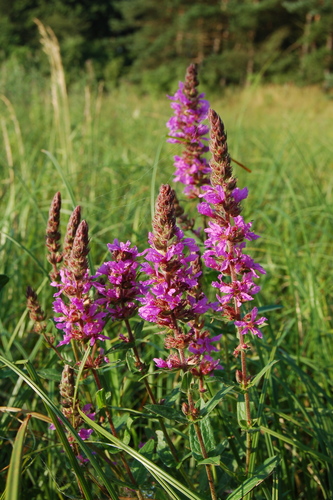
purple loosestrife
Lythrum salicaria
A striking wetland perennial, purple loosestrife is known for its towering spikes of vivid magenta flowers and its controversial role as a master of marshland transformation. While a favorite for bees, this hardy plant's ability to dominate landscapes makes it a fascinating subject for backyard observation.
Quick Identification
Size
Grows 1-2 meters (3-7 feet) in height; individual flower spikes are 10-40 cm (4-16 inches) long.
Colors
Vibrant magenta to reddish-purple petals; stems are green but often turn woody and brown at the base; leaves are deep green.
Key Features
- Distinctive four-to-six sided square-shaped woody stem
- Lance-shaped leaves attached directly to the stem in opposite pairs or whorls of three
- Tall, showy spikes of flowers with 5-7 wrinkled petals each.
When You’ll See Them
Behavior
The plant spreads not only through its prolific seed production but also through a thick underground root system known as a rhizome. It can rapidly transform a diverse marshy area into a monoculture, which significantly reduces the quality of the habitat for birds, amphibians, and other local wildlife that rely on native vegetation for food and nesting sites.
EverydayEarth exclusive
Camera Tips
To capture the best footage of purple loosestrife, treat your camera like a botanical surveyor. Use a Time-Lapse setting to document the plant's growth from early summer through its peak bloom in July. Secure your camera to a t-post or stake about 3 feet off the ground, aiming it at a developing flower spike. Setting the interval to one photo every 4 hours will create a spectacular video of the magenta flowers unfurling over the course of a month.
While the plant itself is stationary, it is a hub for insect activity. To catch visitors like the Cabbage White butterfly or various bumblebees, set your camera to its highest trigger sensitivity and use the 'Burst' mode. Position the lens as close as the focal limit allows—usually about 2 to 3 feet—to capture the intricate details of the 5-7 petaled flowers and the insects moving between them. High-definition video clips of 10-15 seconds are ideal for observing these pollinator interactions.
Lighting is the biggest challenge when filming this species. The intense magenta color can often 'bloom' or overexpose in direct sunlight, losing all the texture of the petals. For the most professional look, position your camera so the sun is behind it or to the side, and try to capture footage during the 'golden hours' of shortly after sunrise or before sunset. If your AI camera allows for exposure compensation, try setting it to -0.5 to keep those deep purple hues rich and saturated.
Because this plant is an invasive species, you can also use your trail camera for environmental management. By placing cameras in different parts of a wetland or backyard creek, you can map the spread of the plant over several seasons. Use the wide-angle setting to get a broad view of the marsh; the distinctive purple haze during late July will make it easy to spot new clusters that need to be managed or reported to local conservation authorities.
Similar Species
Species that look similar or are commonly confused with purple loosestrife.
Fireweed
Fireweed has a round stem and alternating leaves, whereas purple loosestrife has a square stem and opposite or whorled leaves.
Blue Vervain
Blue Vervain has much smaller, blue-tinted flowers on thinner, pencil-like spikes compared to the thick, magenta spikes of loosestrife.
Winged Loosestrife
A native relative that is much smaller and has leaves that are usually alternate rather than opposite.
Frequently Asked Questions
Record purple loosestrife at your habitat
Connect a camera to start building your own species record — AI identifies every visitor automatically.