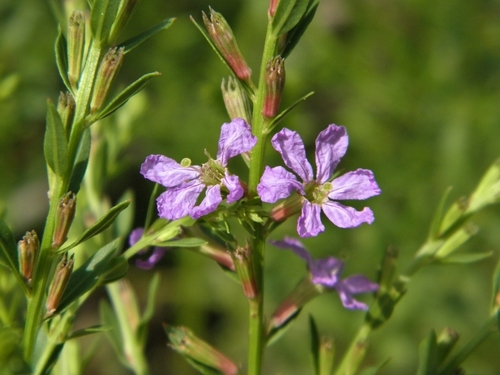
Winged Loosestrife
Lythrum alatum
The elegant, native alternative to invasive wetland plants, Winged Loosestrife offers striking purple blooms and unique winged stems. It is a must-have for any backyard enthusiast looking to support native bees and butterflies.
Quick Identification
Size
Height ranges from 30–120 cm (1–4 ft); Individual flowers are approximately 1.2–1.9 cm (0.5–0.75 in) wide
Colors
Deep purple to rosy-lavender flowers; bright green foliage that can turn reddish in autumn
Key Features
- Distinctive raised 'wings' or ridges along the square-shaped stems
- Solitary flowers appearing in the upper leaf axils rather than dense spikes
- Narrow, lance-shaped leaves that are mostly alternate on the upper stem
- Erect, slender growth habit that is much less bushy than invasive relatives
When You’ll See Them
Behavior
Winged Loosestrife is a graceful, perennial wildflower that brings a quiet dignity to North American wetlands. Unlike its more aggressive and famous cousin, the invasive Purple Loosestrife, this native species grows in small, non-threatening clumps. It doesn't crowd out its neighbors but instead lives in harmony with sedges and grasses in moist prairies and marshes. Its 'behavior' is defined by its steady, reliable blooming cycle, providing a consistent splash of purple from early summer into the cooling days of autumn.
As a key player in its ecosystem, Winged Loosestrife acts as a vital social hub for pollinators. Because its flowers emerge individually along the stem, it encourages bees and butterflies to linger and move methodically up the plant. This species is particularly noted for its relationship with the specialized Melitoma bee and various long-tongued butterflies, making it a high-traffic area for anyone observing backyard insect life. It is a resilient plant, capable of surviving seasonal flooding and then standing tall as the waters recede.
EverydayEarth exclusive
Camera Tips
Capturing the beauty of Winged Loosestrife requires a different approach than filming mobile wildlife. Since the plant is stationary, your goal is to capture its growth progression and the frequent visitors it attracts. Position your camera on a low tripod or a ground stake, roughly 2 to 3 feet from the plant. Aim for a slightly upward angle to catch the light filtering through the purple petals, which gives the flowers a translucent, glowing quality in the morning sun.
Because this species is a pollinator magnet, the best 'action' shots occur during the heat of the day. Set your camera to a high-speed trigger or a short-interval timelapse mode to capture butterflies like the Clouded Sulphur or various native bees visiting the leaf axils. If your camera has a macro setting or a close-focus lens, use it; the 'wings' on the stem are a fascinating architectural feature that looks incredible in high-definition close-ups.
Wind is your biggest challenge when photographing tall, slender wildflowers. To avoid blurry images, try to place your camera on the leeward side of taller shrubs if possible, or use a faster shutter speed setting (1/500 or higher) if your camera allows manual overrides. Early morning offers the 'Golden Hour' lighting that makes the purple hues pop, and the air is generally stillest then, reducing motion blur from the stems swaying.
For a unique seasonal perspective, keep the camera in the same spot for several weeks. Winged Loosestrife has a long blooming period, and a time-lapse showing the flowers opening sequentially from the bottom of the stem to the top provides a stunning visual narrative of the summer season. Ensure your camera is well-camouflaged if placed in a public wetland, but in a backyard rain garden, a simple green housing will blend right in with the surrounding foliage.
Similar Species
Species that look similar or are commonly confused with Winged Loosestrife.
Frequently Asked Questions
Record Winged Loosestrife at your habitat
Connect a camera to start building your own species record — AI identifies every visitor automatically.