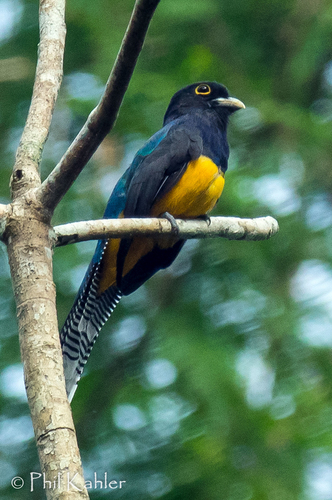
Amazonian Violaceous Trogon
Trogon ramonianus
Decked in iridescent violet and brilliant gold, the Amazonian Violaceous Trogon is a tropical treasure. This elusive forest dweller brings a splash of vibrant color and a hauntingly beautiful call to the Amazonian canopy.
Quick Identification
Size
23 to 25 cm (9 to 10 inches) in length; weighs approximately 45 to 60 grams (1.6 to 2.1 oz)
Colors
Males feature an iridescent violet-blue head and chest with a bright yellow belly. Females are primarily slate-gray where the male is blue. Both have a distinct yellow eye-ring.
Key Features
- Complete yellow eye-ring in males
- Fine black and white horizontal barring on the undertail
- Bright yellow to orange-yellow underparts
- Iridescent violet-blue hood and mantle on males
When You’ll See Them
Geographic range
Where Does the Amazonian Violaceous Trogon Live?
The Amazonian Violaceous Trogon is a classic inhabitant of the South American tropical interior, found throughout the vast Amazon Basin. Its native range spans from the foothills of the Andes in Peru, Ecuador, and Colombia, eastward across the massive rainforests of Brazil to the Atlantic coast. It also occupies southern Venezuela and parts of northern Bolivia, remaining a permanent resident throughout these humid lowland regions.
Basemap © OpenStreetMap contributors
Behavior
The Amazonian Violaceous Trogon is a master of the 'sit-and-wait' foraging technique. It spends long periods perched motionless on horizontal branches in the mid-canopy, scanning for movement. Despite their bright colors, they can be surprisingly difficult to spot until they take flight to snatch an insect or fruit in a quick, acrobatic maneuver known as a sally.
These birds are generally solitary or found in pairs. They are well known for their unique nesting habit of excavating cavities inside active arboreal termite mounds. This provides a stable, temperature-controlled environment and a degree of protection from predators. While not particularly shy, they prefer to remain in shaded areas rather than direct sunlight, making them a challenge for photographers.
EverydayEarth exclusive
Camera Tips
To capture the Amazonian Violaceous Trogon, height is your most important factor. Since these birds favor the mid-canopy, placing your camera at least 10 to 15 feet off the ground is ideal. Look for horizontal branches that offer a clear view of the surrounding foliage, as trogons use these as 'hunting stations' to scan for prey. Angling the camera slightly downward from a higher trunk mount often yields the best results.
If you have fruiting trees in your yard, such as those from the laurel or fig families, these are natural magnets for the species. Set your camera to burst mode or high-speed video, as their 'sallying' flight—where they hover briefly to pluck fruit—is extremely fast and happens in a blink. Early morning light provides the best illumination for their iridescent violet feathers, which can appear dull or black in deep shade or high-contrast midday sun.
A unique 'trail cam' strategy for this species involves locating arboreal termite mounds. During the breeding season, trogons will frequently visit these mounds to excavate their nests. Placing a camera with a wide-angle lens 6-8 feet away from a mound can provide incredible footage of their nesting behavior. Ensure your trigger speed is set to its fastest setting, as trogons are very decisive and quick when approaching their perch. Avoid using white-flash at night near nests, as this can disturb the breeding pair; opt for no-glow infrared instead.
Similar Species
Species that look similar or are commonly confused with Amazonian Violaceous Trogon.
Frequently Asked Questions
Record Amazonian Violaceous Trogon at your habitat
Connect a camera to start building your own species record — AI identifies every visitor automatically.