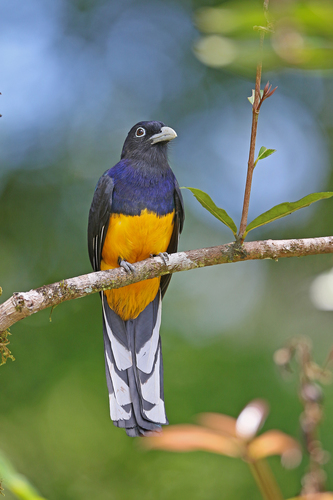
Green-backed Trogon
Trogon viridis
A shimmering jewel of the Amazonian canopy, the Green-backed Trogon is a master of the 'sit-and-wait' lifestyle. With its brilliant yellow underparts and iridescent emerald back, this elusive forest resident is a prize for any backyard or trail camera enthusiast in the tropics.
Quick Identification
Size
Length: 28–30 cm (11–12 in); Weight: 82–102 g (2.9–3.6 oz)
Colors
Male: Iridescent green back, blue head and breast, bright yellow belly, white underside of tail. Female: Dark grey head and breast, greyish-green back, barred tail pattern.
Key Features
- Bright yellow belly without a white breastband
- Iridescent green back and upper tail
- Pale-blue orbital eye-ring
- Distinctive white panels on the underside of the tail
When You’ll See Them
Geographic range
Where Does the Green-backed Trogon Live?
The Green-backed Trogon is a quintessential South American species, with a massive native range spanning the Amazon Basin. It is commonly found across Brazil, Peru, Colombia, Venezuela, and the Guianas, reaching into northern Bolivia. A distinct, disjunct population also exists along the humid Atlantic Forest of southeastern Brazil, where it remains a year-round resident in high-quality tropical habitats.
Basemap © OpenStreetMap contributors
Behavior
The Green-backed Trogon is often described as a 'sluggish' bird due to its habit of sitting motionless on branches for long periods. This behavior is actually a strategic hunting method; the trogon remains still to avoid detection by predators while scanning the mid-canopy for large insects or ripening fruit. When it spots a target, it performs a sudden, acrobatic 'sally,' plucking the item from a leaf or branch mid-flight before returning to its perch.
These birds are generally solitary or found in pairs and are known for their unique nesting habits. Rather than building a traditional nest, they use their powerful bills to excavate cavities inside active arboreal termite mounds. This provides the eggs and chicks with a stable, warm environment and a degree of protection, as the termites continue to live around the nesting cavity without harming the birds.
EverydayEarth exclusive
Camera Tips
To capture high-quality footage of a Green-backed Trogon, you must focus on the mid-story of the forest. These birds rarely descend to the ground, so mounting your AI-powered camera at a height of 10 to 15 feet (3-4.5 meters) is ideal. Look for horizontal, clear branches that serve as 'sallying perches' near fruit-bearing trees like Ficus or various palm species. Because they sit very still, a camera with a high-sensitivity motion sensor or a 'Pre-Trigger' feature is essential to catch the moment they burst into flight.
Lighting is a challenge in the dense rainforest canopy. Position your camera to face north or south to avoid the harsh shadows and blown-out highlights of the equatorial sun, which can obscure the subtle iridescence of the male's green plumage. Using a camera with a high dynamic range (HDR) setting will help balance the bright yellow of their bellies against the dark green foliage of the background.
During the breeding season, keep an eye out for large, bulbous termite mounds attached to tree trunks. If you find one with a fresh, circular hole, it may be an active Green-backed Trogon nest. Setting up a camera at a respectful distance (at least 20 feet) can provide a rare look at their nesting behavior. Avoid using artificial lures or calls, as these birds are sensitive; instead, rely on the natural draw of fruiting trees during the early morning hours when their activity peaks.
Similar Species
Species that look similar or are commonly confused with Green-backed Trogon.
White-tailed Trogon
Found west of the Andes; the Green-backed Trogon was formerly considered the same species but is now distinguished by its range and specific vocalizations.
Black-tailed Trogon
Lacks the white panels on the underside of the tail and typically has a darker, more uniform tail appearance.
Frequently Asked Questions
Record Green-backed Trogon at your habitat
Connect a camera to start building your own species record — AI identifies every visitor automatically.