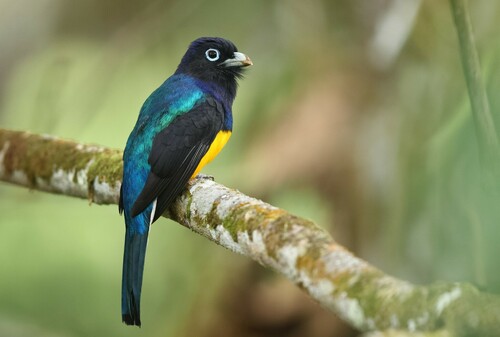
White-tailed Trogon
Trogon chionurus
A jewel of the Chocó rainforest, the White-tailed Trogon captivates observers with its brilliant yellow belly and stoic, regal presence. Often found perched silently among the mossy branches, it is a rewarding find for any backyard explorer in the tropical Americas.
Quick Identification
Size
Length: 28–30 cm (11–12 inches); Weight: 82–102 g (2.9–3.6 oz)
Colors
Males have a deep violet-blue head and breast, a metallic green back, and a vibrant yellow belly. Females are slate-grey on the head and breast. Both sexes feature a largely white underside to the tail.
Key Features
- Solid white undertail with minimal to no black barring
- Vibrant yellow-orange fleshy eye-ring
- Stout, pale bill with a slight hook
- Deep violet-blue head and chest in males
- Upright, stationary perching posture
When You’ll See Them
Behavior
The White-tailed Trogon is a master of the 'sit-and-wait' lifestyle. Unlike many tropical birds that flit restlessly through the canopy, this species spends long periods perched motionless on mid-story branches. They use their keen eyesight to scan the surrounding foliage for large insects or ripening fruits, which they capture by suddenly sallying out and plucking the item mid-air before returning to a perch.
While they are generally solitary or found in pairs, they are not particularly shy around humans if the observer remains still. Their presence is most often given away by their characteristic call—a series of soft, hollow 'kyow' notes. During the breeding season, they become more vocal and may be seen investigating old arboreal termite nests, which they excavate to create their own nesting cavities.
EverydayEarth exclusive
Camera Tips
Capturing a White-tailed Trogon on a trail camera requires targeting their specific perching and feeding habits rather than their flight paths. Because they are canopy and mid-story birds, mounting your camera at ground level is rarely successful. Instead, look for 'hotspot' trees—specifically fruiting trees like wild figs or members of the Lauraceae family. If you can safely secure a camera 10–15 feet up a trunk overlooking a fruiting cluster, your chances of a clear shot increase dramatically.
Since trogons are known for perching motionless for minutes at a time, motion sensors can sometimes be tricky. Use a camera with a high-sensitivity PIR (Passive Infrared) sensor or set the camera to take periodic time-lapse photos during the peak morning hours. If you are using motion triggers, set a short trigger interval (5–10 seconds) to ensure you catch the moment they sally out to grab a fruit and return to the branch.
Light is a major challenge in the humid tropical forests where these birds live. The White-tailed Trogon’s iridescent blue and green feathers can look dull in deep shade but will 'pop' beautifully with a bit of dappled sunlight. Position your camera facing north or south to avoid direct lens flare, and if your camera allows, slightly increase the exposure compensation to account for the dark forest understory. Using a fast shutter speed is essential if you want to freeze the action of their hovering flight during feeding.
Don't forget the importance of weatherproofing. The Chocó region is one of the wettest on earth. Use a dedicated security housing or a silicone 'skin' for your camera, and include a few silica gel packets inside the battery compartment to prevent the lens from fogging internally during the humid mornings. If you are placing the camera near a potential nesting site (like a termite mound), ensure you keep a respectful distance of at least 15–20 feet to avoid disturbing their breeding behavior.
Similar Species
Species that look similar or are commonly confused with White-tailed Trogon.
Frequently Asked Questions
Record White-tailed Trogon at your habitat
Connect a camera to start building your own species record — AI identifies every visitor automatically.