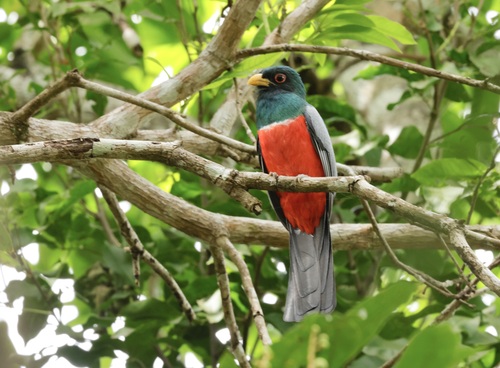
Black-tailed Trogon
Trogon melanurus
A hidden gem of the Amazonian lowlands, the Black-tailed Trogon is defined by its shimmering green back and brilliant crimson belly. Unlike its cousins, its tail remains a deep, solid black, making it a unique prize for backyard observers and forest trekkers alike.
Quick Identification
Size
28–30 cm (11–12 in) in length; weighs between 82–110 g (2.9–3.9 oz)
Colors
Males feature a metallic green head and back, bright red belly, and a solid black undertail. Females have a slate-grey head and breast with a red belly and yellow bill.
Key Features
- Solid black undertail without white barring
- Bright red belly separated by a white chest band
- Thick yellow bill and orange-yellow eye ring
- Upright, vertical perching posture
When You’ll See Them
Geographic range
Where Does the Black-tailed Trogon Live?
The Black-tailed Trogon is a quintessential bird of the Neotropics, primarily inhabiting the vast rainforests of South America and parts of southern Central America. Its range extends from Panama down through the Amazon Basin, covering significant portions of Colombia, Venezuela, Ecuador, Peru, Bolivia, and Brazil. It is most frequently encountered in lowland environments where humidity is high and the canopy is dense.
Basemap © OpenStreetMap contributors
Behavior
The Black-tailed Trogon is characterized by its stoic and somewhat sedentary nature. It is a 'sit-and-wait' predator, often spending long intervals perched motionless on mid-level branches while scanning the surrounding foliage for movement. Despite their vibrant plumage, they are remarkably difficult to spot until they take flight, as they prefer the shaded interiors of the forest canopy.
Socially, these birds are typically found alone or in pairs. They are not known for long-distance migration, preferring to stay within their established territories year-round. During the breeding season, they become more vocal, using a series of resonant, rhythmic hooting calls to signal to mates or rivals. They are cavity nesters, often utilizing the abandoned nests of termites or excavating holes in decaying wood.
EverydayEarth exclusive
Camera Tips
To capture high-quality images of the Black-tailed Trogon, you should focus your efforts on the mid-canopy layer. Place your camera roughly 10 to 15 feet off the ground, ideally on a horizontal branch that overlooks a small clearing or a cluster of fruiting trees. These birds are creatures of habit and will often return to the same 'sentinel' perches day after day to scan for insects. If you can identify a branch with clear sightlines and a bit of shade, that is your prime location.
Because trogons are often found in the deep, dark understory of the rainforest, light is your biggest challenge. Use a camera with a high-performance sensor that can handle low-light conditions without excessive grain. If you are using a trail camera, set the trigger sensitivity to 'High.' Trogons often sit perfectly still for five to ten minutes at a time, and a slow trigger might miss the sudden, explosive sally when they dive to catch an insect or grab a berry.
While they don't visit traditional seed feeders, you can increase your chances of a 'visit' by placing your camera near active termite mounds or decaying stumps, which they use for nesting. If you are in a backyard setting that borders tropical forest, planting native fruit-bearing trees like Ficus or members of the laurel family will act as a natural lure. Avoid using artificial flashes if possible, as the sudden burst of light in a dark forest can startle them and discourage them from returning to that specific perch.
Similar Species
Species that look similar or are commonly confused with Black-tailed Trogon.
Frequently Asked Questions
Record Black-tailed Trogon at your habitat
Connect a camera to start building your own species record — AI identifies every visitor automatically.