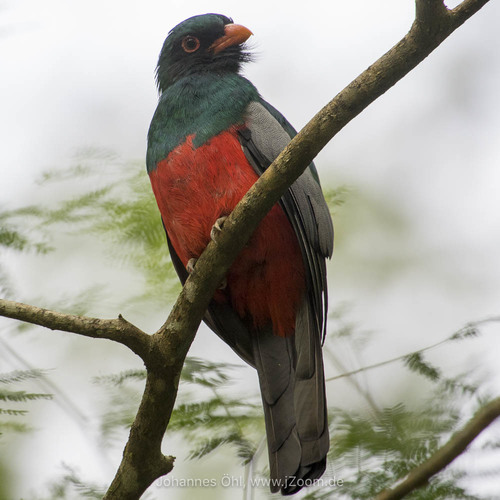
Slaty-tailed Trogon
Trogon massena
A vibrant dweller of the tropical canopy, the Slaty-tailed Trogon is a study in brilliant contrasts. With its emerald-green plumage and deep crimson belly, this bird brings a touch of prehistoric elegance to any rainforest backyard.
Quick Identification
Size
30–35 cm (12–14 in) in length; weighs approximately 145–165 g (5.1–5.8 oz)
Colors
Males feature a metallic green head, back, and breast with a vibrant red belly and a thick orange-red bill. Females are slate-grey where the male is green and have a darker bill.
Key Features
- Solid slaty-grey underside of the tail without white barring
- Heavy, serrated orange-red bill (brightest in males)
- Vibrant red lower underparts and belly
- Upright, motionless perching posture
When You’ll See Them
Behavior
The Slaty-tailed Trogon is a master of patience. Often found in the mid-to-upper canopy of humid forests, these birds spend long periods sitting perfectly still on horizontal branches. They scan their surroundings with large, dark eyes for movement, only breaking their statue-like pose for a sudden, explosive burst of flight to pluck a fruit or snatch a large insect from the foliage.
While they are relatively solitary outside of the breeding season, they are known for their distinctively rhythmic, barking call—a series of 'kyow' notes that can resonate through the forest for several minutes. Despite their bright colors, they can be surprisingly difficult to spot until they move, as their green backs blend seamlessly with the tropical leaves.
One of their most fascinating behaviors is their nesting habit. They are specialized excavators that carve out nesting cavities inside active arboreal termite mounds. This provides them with a regulated temperature and a level of protection from some predators, though it requires significant effort from both the male and female during the construction phase.
EverydayEarth exclusive
Camera Tips
To capture the Slaty-tailed Trogon on your AI-powered camera, placement is everything. These birds are canopy-dwellers that rarely descend to the ground. If you have a backyard bordering a forest, look for fruiting trees like Ficus or Lauraceae. Mount your camera at a height of at least 8 to 12 feet, angled slightly upward toward horizontal perches that have a clear line of sight to the fruit. Trogons prefer 'sallying' perches—branches where they can sit and look for food before flying out to grab it.
During the breeding season (typically spring and early summer), keep an eye out for large, bulbous termite mounds attached to tree trunks. If you spot one with a fresh hole about 2 to 3 inches in diameter, you have found a potential goldmine. Position your camera on a neighboring tree facing the mound. Use a medium-to-high trigger sensitivity, as trogons can be surprisingly quick when entering or exiting the nest. Because these nests are often in deep shade, ensure your camera has excellent low-light performance or IR capabilities that won't blow out the details of the bird's feathers.
If you are trying to attract them to a specific spot, natural lures are best. They aren't typical bird feeder visitors, but maintaining a garden with native fruit-bearing trees is the most effective way to bring them into camera range. If your camera supports video, set it to record at least 15-20 seconds. Trogons often sit still for long stretches, and a short 5-second clip might only capture them looking like a colorful statue; longer clips increase your chances of seeing their unique 'tail-wag' or a feeding strike.
Similar Species
Species that look similar or are commonly confused with Slaty-tailed Trogon.
Black-headed Trogon
Has a pale blue eye-ring and conspicuous white tips on the underside of the tail feathers, unlike the solid slaty tail of T. massena.
Lattice-tailed Trogon
Very similar but found at higher elevations; look for the fine white barring on the tail feathers which the Slaty-tailed lacks.
Frequently Asked Questions
Record Slaty-tailed Trogon at your habitat
Connect a camera to start building your own species record — AI identifies every visitor automatically.