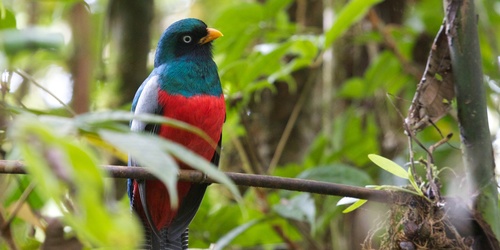
Lattice-tailed Trogon
Trogon clathratus
A hidden gem of the Central American rainforest, the Lattice-tailed Trogon is named for the exquisite, lace-like patterns hidden beneath its tail. This iridescent emerald and ruby resident is a master of the humid Caribbean slopes.
Quick Identification
Size
29-31 cm (11.5-12.2 inches) in length; weighs approximately 85-110g (3-3.8 oz)
Colors
Males feature an iridescent green head and back, a bright red belly, and a yellow bill. Females are slaty-gray with a similar red belly.
Key Features
- Intricate white-on-black lattice pattern on the underside of the tail
- Bright red belly with no white breast band
- Pale white or yellow iris
- Stocky, upright perching posture
When You’ll See Them
Geographic range
Where Does the Lattice-tailed Trogon Live?
Native to the lush tropical corridors of Central America, the Lattice-tailed Trogon is a regional specialist found exclusively on the Caribbean slope. Its core range spans from eastern Costa Rica through western and central Panama. It thrives in the humid, high-rainfall environments of the Atlantic lowlands and foothills where primary rainforest remains intact.
Basemap © OpenStreetMap contributors
Behavior
The Lattice-tailed Trogon is a classic "sit-and-wait" predator of the tropical mid-story. It spends significant portions of its day perched motionlessly on horizontal branches, its large eyes scanning for the slightest movement of an insect or the glint of a ripening berry. When prey is spotted, the trogon executes a sudden, acrobatic sally, hovering briefly to pluck its target from the foliage before returning to a nearby perch to consume it.
Unlike many tropical birds that travel in noisy flocks, this species is generally solitary or found in quiet pairs. They are known for being somewhat sluggish and approachable, often allowing observers to get quite close before they fly off with an undulating flight pattern. Their presence is often revealed more by their voice—a series of soft, resonant, accelerating hoots—than by their movement through the dense Caribbean slope forests.
EverydayEarth exclusive
Camera Tips
To capture the Lattice-tailed Trogon on your camera, focus your efforts on the mid-story rather than the forest floor. These birds prefer perching on horizontal branches between 5 and 15 feet off the ground. Mount your camera on a tree trunk overlooking a small clearing or a "light gap" where a tree has fallen. Trogons love these edges because they provide high visibility for hunting insects. Angle the lens slightly upward to ensure you capture the brilliant red of the belly and the crucial lattice details on the tail.
While they won't visit standard bird feeders, you can entice them by placing cameras near native fruiting trees, particularly those in the nutmeg (Virola) or laurel families. Because they are "sit-and-wait" hunters, they often remain still for minutes at a time. Set your camera's trigger sensitivity to high and utilize a high-speed burst mode. This ensures that when the bird finally makes its lightning-fast sally for food, you catch the action rather than just an empty branch.
Lighting in the humid rainforest is often dim and dappled, which can trick auto-exposure settings. If your camera allows, set a slightly higher ISO or use a fast shutter speed to prevent motion blur during their quick flights. Early morning is the golden hour for this species; they are most vocal and active just as the sun begins to penetrate the canopy. If your property borders a forested area, keeping a water source like a high-placed birdbath might occasionally lure them down for a drink or a splash.
Similar Species
Species that look similar or are commonly confused with Lattice-tailed Trogon.
Frequently Asked Questions
Record Lattice-tailed Trogon at your habitat
Connect a camera to start building your own species record — AI identifies every visitor automatically.