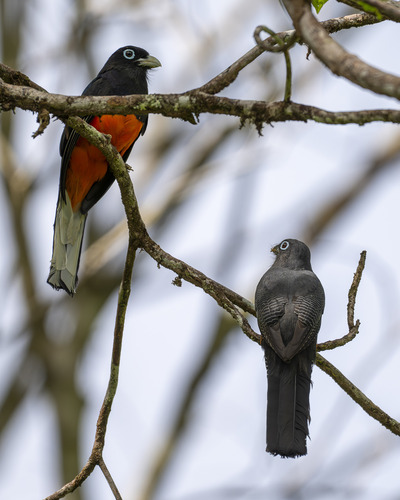
Baird's Trogon
Trogon bairdii
A stunning violet and vermillion inhabitant of the Pacific lowlands, the Baird's Trogon is one of Central America's most spectacular and localized avian gems.
Quick Identification
Size
Length: 25–28 cm (10–11 in); Weight: 75–95 g (2.6–3.4 oz)
Colors
Males have violet-blue heads/chests and vermillion bellies; females are slate-grey with pale red bellies. Both have pale blue eye-rings.
Key Features
- Vibrant vermillion-red belly
- Distinctive pale blue eye-ring
- Violet-blue head and breast in males
- Square-tipped tail with fine white and black barring
When You’ll See Them
Geographic range
Where Does the Baird's Trogon Live?
Baird's Trogon is a localized treasure of Central America, found exclusively on the Pacific slope of southern Costa Rica and western Panama. It is a true lowland specialist, concentrated in the lush, humid forests of the Osa Peninsula and the Chiriquí province. Because it does not migrate and has a very restricted global footprint, it is considered a high-priority species for conservationists and birders alike in the region.
Basemap © OpenStreetMap contributors
Behavior
Baird's Trogons are relatively sedentary birds, known for their 'sit-and-wait' strategy. They often spend long periods perched motionless on mid-story branches, scanning the surrounding foliage for prey or fruit. This stillness makes them masters of camouflage despite their bright colors, though they are easily detected once they give their characteristic barking 'kyow' calls.
When they spot a meal, they exhibit a sudden burst of energy, sallying out to pluck fruit or snatch large insects from the underside of leaves before returning to a perch. They are generally solitary outside of the breeding season, though pairs may be seen together near nesting sites, which are typically holes excavated in rotting trees or active termite mounds.
EverydayEarth exclusive
Camera Tips
To successfully capture a Baird's Trogon on camera, you must focus on the mid-story layer of the forest. These birds rarely descend to the forest floor, so mounting your camera at human eye level or slightly higher, perhaps on a balcony or a sloping hillside, is essential. Look for horizontal, relatively open branches where the bird has a clear flight path to sally for food; these are their preferred perching spots.
The secret to attracting them is the presence of fruiting trees. If you have wild avocados or 'Aguacatillo' trees in your area, aim your camera toward the clusters of ripening fruit. Trogons are particularly fond of these and will return to the same tree daily until the fruit is gone. Because they sit so still, use a camera with a sensitive motion trigger or consider using time-lapse mode during the early morning hours when they are most active.
Lighting can be a challenge in the dense, humid forest. If your camera allows, adjust for a higher ISO or use a fill flash to bring out the iridescent violet and deep red of the plumage, which can otherwise look dark in the forest shade. Set your video length to at least 15-20 seconds; Baird's Trogons often sit perfectly still for several seconds before making a sudden, dramatic move to catch an insect, and you don't want to miss the action.
Similar Species
Species that look similar or are commonly confused with Baird's Trogon.
Frequently Asked Questions
Record Baird's Trogon at your habitat
Connect a camera to start building your own species record — AI identifies every visitor automatically.