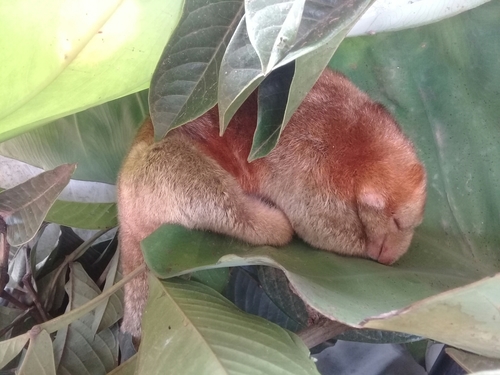
Amboro Silky Anteater
Cyclopes catellus
The Amboro Silky Anteater is a golden phantom of the Bolivian canopy. As the smallest anteater in the world, this nocturnal gymnast spends its life suspended in the trees, hidden by its shimmering, silk-like fur.
Quick Identification
Size
Length 36-45 cm (14-18 in) including tail; weight 175-400 g (6-14 oz)
Colors
Uniformly golden-yellow to honey-brown fur; unlike many cousins, it typically lacks a dark stripe on the belly (ventral) and has a faint or absent dorsal stripe.
Key Features
- Two large, curved claws on each front paw
- Thick, prehensile tail for arboreal navigation
- Soft, dense fur with a silky sheen
- Small, rounded head with a short snout and no visible ears
When You’ll See Them
Geographic range
Where Does the Amboro Silky Anteater Live?
This species is a South American specialist endemic to the heart of the continent. It is found exclusively in Bolivia, specifically along the eastern slopes of the Andes mountains and the transitional forest zones of the Amboró National Park. Its range is highly localized compared to other silky anteaters, making it a rare prize for wildlife observers in the region.
Basemap © OpenStreetMap contributors
Behavior
The Amboro Silky Anteater is a master of cryptic living, spending its entire existence in the tropical canopy. It is strictly nocturnal, beginning its activity at dusk to forage for ants among the branches. During the daylight hours, it performs a remarkable disappearing act by curling into a tight, spherical ball. In this position, its golden fur blends perfectly with the seed pods of the silk-cotton tree, protecting it from the keen eyes of hawks and harpy eagles.
This species is solitary and moves with a slow, deliberate 'sloth-like' pace to avoid detection. Despite its gentle appearance, it possesses a unique defensive posture. When threatened and unable to flee, it stands on its hind legs, supporting itself with its prehensile tail, and holds its sharp-clawed front paws near its face in a 'boxer' stance, ready to strike at an intruder's eyes or nose.
EverydayEarth exclusive
Camera Tips
Capturing the Amboro Silky Anteater on a trail camera requires thinking vertically. Because they never descend to the forest floor, ground-mounted cameras will miss them entirely. You should mount your camera between 5 and 15 feet high, focusing on horizontal 'canopy bridges'—thick lianas or branches that connect the crowns of large trees. Look for areas with high concentrations of arboreal ant nests, as these are the species' primary food sources.
These animals move slowly and have a small heat signature, which can fail to trigger standard PIR sensors. Set your camera to its highest sensitivity and use a fast trigger speed. Because they are strictly nocturnal, a 'No-Glow' infrared flash is essential; a standard white flash or even a 'Low-Glow' red LED may startle them or cause them to freeze in place for hours. Video mode is highly recommended, as it is often easier to spot their slow, rhythmic movement in a recording than in a single still photo where they might look like a clump of moss.
While you cannot easily bait an anteater with food, you can increase your chances by placing cameras near Ceiba trees (silk-cotton trees). Silky anteaters are known to favor these trees for sleeping because their golden fur provides perfect camouflage against the tree's fluffy seed pods. If you find a potential sleeping site, aim the camera at the surrounding branches to catch the individual as it wakes up and begins its nightly foraging routine.
Similar Species
Species that look similar or are commonly confused with Amboro Silky Anteater.
Frequently Asked Questions
Record Amboro Silky Anteater at your habitat
Connect a camera to start building your own species record — AI identifies every visitor automatically.