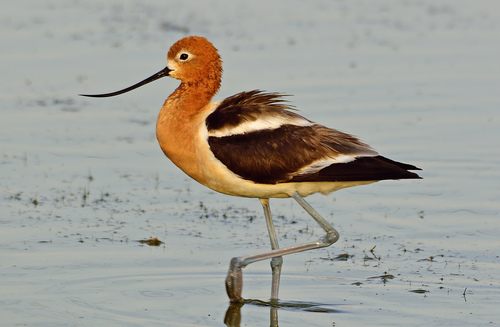
American Avocet
Recurvirostra americana
With its elegantly upturned bill and striking cinnamon breeding plumage, the American Avocet is one of North America's most recognizable shorebirds. Watching these 'blue-stockings' sweep through shallow water is a masterclass in avian grace.
Quick Identification
Size
Length 16–20 inches (41–51 cm); wingspan 27–30 inches (68–76 cm); weight 9.7–14.8 oz (275–420 g)
Colors
White body with black wing patches and two black stripes on the back; long, bluish-gray legs; head and neck are cinnamon-orange during breeding season and pale gray during winter.
Key Features
- Long, thin, distinctively upturned black bill
- Striking cinnamon-colored head and neck in breeding plumage
- Long, spindly blue-gray legs
- Bold black and white wing pattern visible in flight
When You’ll See Them
Geographic range
Where Does the American Avocet Live?
Native to North America, the American Avocet thrives across the western and midwestern United States and southern Canada during the breeding season. As winter approaches, these elegant waders migrate toward the coasts, settling in the southern United States, Mexico, and parts of Central America and the Caribbean. Their presence is most notable in the Great Basin and the Great Plains, where they frequent large, shallow bodies of water and seasonal wetlands.
Basemap © OpenStreetMap contributors
Behavior
The American Avocet is a highly active and social wader, often seen in small flocks alongside other shorebirds. Their most distinctive behavior is their unique feeding method: they walk through shallow water with their bills partially submerged, sweeping them from side to side in a 'scything' motion to stir up and catch aquatic invertebrates. This rhythmic movement is a telltale sign of the species from a distance.
During the nesting season, these birds are fiercely territorial and protective of their young. They are known to perform elaborate 'broken-wing' displays to lure potential predators away from their nests. When threatened, they may also emit a loud, piercing 'wheep' call and even dive-bomb intruders, including humans who venture too close to their nesting colonies on mudflats or islands.
EverydayEarth exclusive
Camera Tips
To capture the American Avocet on camera, focus on the 'transition zone' where shallow water meets the shore. Because these birds forage in water that is only a few inches deep, place your camera on a low-profile stake or a waterproof mount just inches above the mud line. Aim the lens parallel to the water's surface to get that professional 'eye-level' perspective, which highlights the unique curve of their bill and their long 'blue' legs.
Since Avocets are most active during the day, lighting is your best friend. Position your camera so it faces away from the sun (North or South) to avoid harsh lens flares or silhouetting. Early morning light (the 'golden hour') is particularly effective for illuminating the cinnamon-orange plumage of breeding adults. If your camera allows for video or burst mode, use it; their side-to-side scything motion is much more impressive in motion than in a single still frame.
Avocets are wary of movement but can be habituated to stationary objects. If you are setting up a trail cam in a backyard wetland or near a pond, camouflage the housing with local reeds or grasses. No bait is necessary, as they are looking for natural aquatic life, but ensuring your pond has a shallow, sloping 'beach' area rather than steep banks will significantly increase your chances of a visit. Set your trigger speed to the fastest possible setting, as their sweeping head movements and quick flights can be quite rapid.
Similar Species
Species that look similar or are commonly confused with American Avocet.
Black-necked Stilt
Has bubblegum-pink legs and a straight bill, whereas the Avocet has blue-gray legs and an upturned bill.
Greater Yellowlegs
Smaller with bright yellow legs and a mottled gray/brown body, lacking the bold black-and-white wing stripes.
Marbled Godwit
Features a long, slightly upturned bill, but has cinnamon-mottled plumage overall without the Avocet's bold black-and-white patterns.
Frequently Asked Questions
Record American Avocet at your habitat
Connect a camera to start building your own species record — AI identifies every visitor automatically.