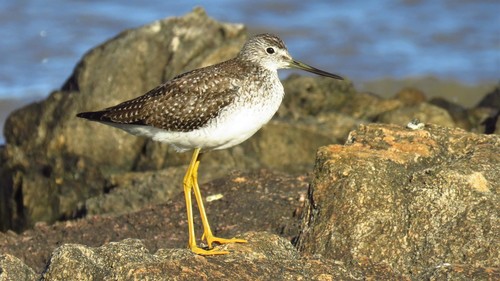
Greater Yellowlegs
Tringa melanoleuca
With its sunshine-bright legs and spirited 'tew-tew-tew' call, the Greater Yellowlegs is the elegant sentinel of the marsh. A champion of long-distance migration, this striking shorebird brings a dash of wild energy to wetlands across the Americas.
Quick Identification
Size
Length: 11.4-15.4 in (29-39 cm); Wingspan: 23-26 in (58-65 cm); Weight: 3.9-8.3 oz (111-235 g)
Colors
Checkered grayish-brown and white upperparts; white underparts with dark streaking on the neck and breast; bright, long yellow legs; long, dark bill often slightly upturned.
Key Features
- Bright yellow, long legs
- Long, slightly upturned bill (longer than the head)
- Speckled grayish-brown plumage
- Loud, three-note whistled call 'tew-tew-tew'
When You’ll See Them
Sightings on EverydayEarth
Mar 31, 2026
A peaceful early morning scene at the refuge shows several bird species sharing a shallow marsh. In the foreground, a White-faced Ibis preens its feathers near the reeds while a Greater Yellowlegs forages actively in the center. To the right, a Black-necked Stilt stands on its exceptionally long legs. In the background, a Northern Pintail swims across the calm water as the morning sun illuminates the dry vegetation.
Geographic range
Where Does the Greater Yellowlegs Live?
Native to the Western Hemisphere, the Greater Yellowlegs breeds in the muskeg and boggy regions of central Canada and southern Alaska. During the non-breeding season, it occupies a massive range that stretches from the coastal United States and the Gulf of Mexico through Central America and the West Indies, reaching as far south as Tierra del Fuego in South America. It is a common sight across North American interior wetlands during its long-distance spring and fall migrations.
Basemap © OpenStreetMap contributors
Behavior
The Greater Yellowlegs is famously known as the 'marsh tell-tale.' Highly vocal and alert, this shorebird is often the first to sound a piercing, multi-note alarm call when it perceives a threat, alerting every other animal in the vicinity. Unlike many of its more sedate relatives, the Greater Yellowlegs is incredibly active, frequently seen bobbing its head and tail rhythmically or running through shallow water with high, splashing strides while hunting.
These birds are solitary or found in small, loose groups rather than the dense, synchronized flocks typical of other sandpipers. They exhibit a unique foraging behavior where they run through the water to chase small fish or sweep their bills side-to-side to stir up aquatic insects. While they are wary of humans and will flush if approached, they are bold in their environment and provide excellent viewing opportunities from a distance.
EverydayEarth exclusive
Camera Tips
To successfully capture a Greater Yellowlegs on a trail camera, placement is everything. These birds are 'edge specialists' that prefer the interface between mud and shallow water. Set your camera on a low-profile mount just 6-12 inches above the ground at the edge of a pond, marsh, or even a large, persistent puddle in a field. Aiming the camera horizontally across the water's surface will provide a dramatic perspective and often catch a beautiful reflection of the bird's iconic yellow legs.
Because the Greater Yellowlegs is a fast-moving predator, avoid using standard motion-trigger settings that might result in 'tail-end' shots. If your camera has a high-speed burst mode or a 'Fast' trigger speed (under 0.25 seconds), enable it. Use a high shutter speed setting if available to freeze the action of the bird running or 'scything' its bill through the water. These birds are most photogenic during the 'golden hours' of early morning and late afternoon when the low sun angle highlights their plumage texture.
If you are trying to attract them to a specific backyard spot, traditional birdseed won't work. Instead, focus on water features. A shallow, sloping basin or a mud-edged pond with a solar-powered water dripper is a powerful lure. The sound of moving water is a signal to migrating shorebirds that a foraging spot is nearby. Ensure the camera is well-camouflaged with natural reeds or grasses, as their keen eyes are designed to spot even the slightest movement or unusual shape in their open habitat.
Similar Species
Species that look similar or are commonly confused with Greater Yellowlegs.
Lesser Yellowlegs
Noticeably smaller with a perfectly straight, shorter bill that is roughly the same length as its head.
Solitary Sandpiper
Smaller with olive-green or dark legs instead of bright yellow, and a prominent white eye-ring.
Willet
Larger and stockier with grayish legs and a bold black-and-white wing pattern visible in flight.
Frequently Asked Questions
Record Greater Yellowlegs at your habitat
Connect a camera to start building your own species record — AI identifies every visitor automatically.