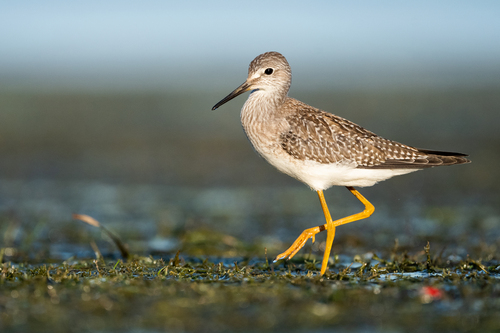
Lesser Yellowlegs
Tringa flavipes
A long-distance traveler with stilt-like golden legs and a refined silhouette, the Lesser Yellowlegs brings a touch of wild wetland elegance to any backyard camera setup near water.
Quick Identification
Size
Length: 23–27 cm (9–11 in); Wingspan: 59–64 cm (23–25 in); Weight: 67–94 g (2.4–3.3 oz)
Colors
Speckled grey-brown upperparts, white underparts with light streaking on the breast; bright, high-contrast yellow legs and a thin black bill.
Key Features
- Bright yellow, stilt-like legs
- Straight, slender black bill roughly the length of its head
- White rump visible in flight
- Frequent 'bobbing' or 'teetering' motion when standing
When You’ll See Them
Geographic range
Where Does the Lesser Yellowlegs Live?
Native to North America, the Lesser Yellowlegs breeds across the vast boreal forest region spanning from Alaska through central and eastern Canada. As a long-distance migrant, its range expands dramatically during the winter months to cover nearly all of Central and South America, as well as the Caribbean. You can find them throughout the United States during their biannual journeys, particularly in the Great Plains and along both the Atlantic and Pacific flyways as they stop to refuel at inland wetlands.
Basemap © OpenStreetMap contributors
Behavior
The Lesser Yellowlegs is a graceful, energetic shorebird known for its active foraging style. Unlike some more stoic waders, these birds are constantly on the move, picking at the water's surface or running through shallows to flush out prey. They are highly vocal, often giving a sharp, two-note 'tu-tu' call when startled or while flying between feeding spots. Their most recognizable habit is a rhythmic bobbing of the head and tail, a behavior shared with other sandpipers but executed with a particular elegance in this species.
During migration, they are social birds, often found in small to medium-sized flocks, sometimes mixing with their larger relative, the Greater Yellowlegs. While they are wary of sudden movements, they can become quite habituated to humans if approached quietly in public parks or coastal walkways. They spend the majority of their day foraging to fuel their incredible long-distance migrations, resting briefly on mudflats or logs during high tide.
EverydayEarth exclusive
Camera Tips
To capture the Lesser Yellowlegs, position your camera at the very edge of shallow water, specifically targeting mudflats or areas with water only 1-2 inches deep. This species prefers foraging where its yellow legs are still visible, so avoid deep reeds. Use a low-profile mount—no more than 6 to 12 inches off the ground—to achieve an intimate, eye-level perspective that makes the bird's long legs look particularly striking against the water.
Because shorebirds are small and move with quick, jerky motions, set your AI camera to its highest sensitivity and use a fast shutter speed if the software allows. A 'burst mode' or 'photo-first' setting is essential; these birds often pause for only a second before darting forward, and you want to catch the moment their beak breaks the surface or they perform their signature tail bob.
If you are setting up in a backyard, you can attract them during migration by maintaining a 'muddy' zone near a pond or bird bath. Unlike songbirds, they won't use a traditional pedestal bath; they need ground-level water with a very shallow, sloping entry. Early morning light is your best friend, as it will make those iconic yellow legs 'pop' against the darker mud and provide the best illumination for the fine white speckling on their wings.
Similar Species
Species that look similar or are commonly confused with Lesser Yellowlegs.
Greater Yellowlegs
Larger body and a longer bill that is often slightly upturned and more than 1.5x the length of the head.
Solitary Sandpiper
Darker legs (olive-green rather than bright yellow) and a prominent white eye-ring.
Stilt Sandpiper
Slightly drooping bill and greenish legs; lacks the bright, clean yellow legs of the Lesser Yellowlegs.
Frequently Asked Questions
Record Lesser Yellowlegs at your habitat
Connect a camera to start building your own species record — AI identifies every visitor automatically.