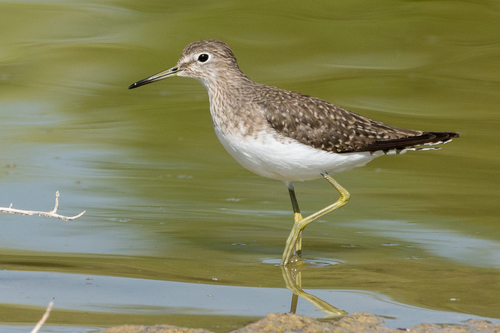
Solitary Sandpiper
Tringa solitaria
The Solitary Sandpiper is the hidden gem of the wetlands, an elegant traveler that eschews the crowds for the quiet of wooded ponds. With its striking white eye-ring and rhythmic tail-bob, it brings a touch of wild mystery to any backyard water feature during its seasonal migrations.
Quick Identification
Size
Length: 19–23 cm (7.5–9.1 in); Wingspan: 38–43 cm (15–17 in); Weight: 31–65 g (1.1–2.3 oz)
Colors
Dark olive-brown or grayish upperparts with fine white speckling; white underparts with distinct dusky streaking on the neck and breast; bold, prominent white eye-ring; dull greenish-yellow legs.
Key Features
- Bold white eye-ring
- Dark wings with fine white spotting
- Dark rump and central tail feathers (no white rump)
- Greenish or yellowish-green legs
- Rhythmic tail-bobbing behavior
When You’ll See Them
Behavior
As its name suggests, the Solitary Sandpiper is a bit of an introvert in the bird world. While most shorebirds gather in massive, swirling flocks on coastal beaches, this species is typically found alone or in very small groups. It prefers the quiet seclusion of inland freshwater, such as wooded swamps, shaded pond edges, or even large puddles in suburban parks. It moves with a graceful, deliberate gait, frequently pausing to bob its tail up and down—a characteristic trait that helps birdwatchers identify it from a distance.
One of the most fascinating aspects of this bird is its nesting habit. Unlike almost all other shorebirds that nest on the ground, the Solitary Sandpiper heads into the trees. It utilizes abandoned nests of songbirds like American Robins, Gray Catbirds, or Rusty Blackbirds, often 10 to 40 feet off the ground. When it feels threatened, it takes flight with a quick, zig-zagging motion and emits a sharp, shrill 'peet-weet' call, which often alerts other nearby wildlife to potential danger.
EverydayEarth exclusive
Camera Tips
To capture the Solitary Sandpiper on a trail camera, you need to think small and wet. Forget the open lakeshores; instead, target 'micro-wetlands.' Look for areas in your yard or local woods where water pools after a heavy rain, or the muddy, shaded edges of a small garden pond. These birds love cover, so placing your camera near overhanging vegetation or fallen logs along the water's edge is ideal. Because they are low-slung birds, your camera should be mounted very low—ideally 6 to 10 inches off the ground—and angled slightly upward to capture their reflection in the water, which adds a stunning professional quality to your shots.
Since these birds are highly migratory, timing is the most important factor. They are most likely to trigger your camera during the spring (late April to May) and the fall (late July through September). During these windows, set your camera to a high-sensitivity trigger with a short 'recovery time' or use a 'burst mode' that takes 3-5 photos per trigger. Their tail-bobbing and quick pecking motions can sometimes trick lower-end sensors, so a high-quality video setting of 10-20 seconds is often better for capturing their unique personality than a single still photo.
Lighting can be tricky near water. To avoid 'white-out' from sun glare reflecting off the mud or water, try to position your camera facing North. This provides consistent, even lighting throughout the day. If you want to encourage them to spend more time in front of the lens, you don't need a bird feeder; simply keeping a small patch of shoreline clear of tall grass so the mud is exposed will provide them with a natural foraging ground that they find irresistible. Finally, ensure your camera has a fast shutter speed to freeze their movement, as they are surprisingly quick when they spot a tasty aquatic larva.
Similar Species
Species that look similar or are commonly confused with Solitary Sandpiper.
Spotted Sandpiper
Spotted Sandpipers have large black belly spots in summer and a more continuous, frantic tail-wagging motion.
Lesser Yellowlegs
Larger with much longer, brighter yellow legs and a bright white rump that is very obvious in flight.
Green Sandpiper
An Old World species that looks very similar but has a brilliant white rump and darker underwings.
Frequently Asked Questions
Record Solitary Sandpiper at your habitat
Connect a camera to start building your own species record — AI identifies every visitor automatically.