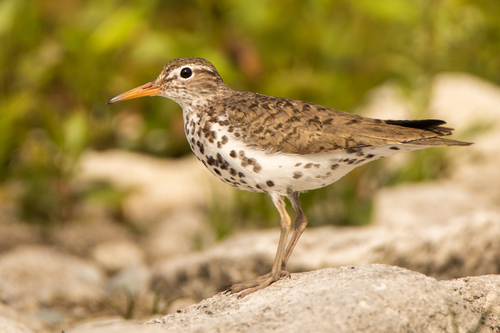
Spotted Sandpiper
Actitis macularius
The Spotted Sandpiper is the energetic 'teeter-totter' of the shoreline. Known for its rhythmic tail-bobbing and unique role-reversing family life, this charismatic bird is a delight to discover near any backyard water source.
Quick Identification
Size
Length: 7.1–7.9 in (18–20 cm); Wingspan: 14.6–15.7 in (37–40 cm); Weight: 1.2–1.8 oz (34–50 g)
Colors
Breeding adults have bold black spots on a white breast with an olive-brown back; non-breeding adults have plain white underparts and grayish-brown backs. Yellowish-orange legs.
Key Features
- Constant 'teetering' or rhythmic bobbing of the tail
- Large dark spots on white underparts during breeding season
- Shallow, stiff-winged flight pattern low over water
- Thin white wing stripe visible during flight
When You’ll See Them
Behavior
The Spotted Sandpiper is one of the most widespread shorebirds in North America, easily identified by its distinctive "teetering" walk—a constant, rhythmic bobbing of the tail and rear end. Unlike many other shorebirds that gather in large, anonymous flocks, these sandpipers are typically solitary or found in small family groups, patrolling the muddy or rocky edges of water bodies with a nervous, energetic gait.
Their social structure is a fascinating outlier in the bird world. They practice polyandry, a system where females are the more aggressive defenders of territory and may mate with multiple males in a single season. After the female lays a clutch of eggs, the male often takes over the primary duties of incubation and chick-rearing. When startled, they fly low over the water with very stiff wingbeats, rarely raising their wings above the horizontal plane, while emitting a sharp, repeating call.
EverydayEarth exclusive
Camera Tips
To successfully capture a Spotted Sandpiper on camera, you must think like a creature that lives at ground level. These birds spend 90% of their time on the very edge of the water. Mount your camera extremely low—no more than 6 to 10 inches off the ground—aiming parallel to the shoreline. If you have a backyard pond or a creek, look for a flat rock or a muddy 'beach' area; these are their preferred landing strips. A low-angle shot not only captures their unique tail-bobbing behavior but also creates a more professional, intimate perspective that brings the viewer into the bird's world.
Because the Spotted Sandpiper is a small, fast-moving target, your camera settings are crucial. Set your PIR (Passive Infrared) sensor to 'High' to ensure the heat signature of a small bird triggers the shutter. Use a fast trigger speed (0.2s to 0.4s) and consider a 'Burst Mode' of 3-5 photos or a 15-second video clip. If your camera supports high-frame-rate video, 60fps is ideal for slowing down their rapid teetering and stiff-winged flight in post-processing. Be mindful of 'false triggers' caused by moving water or sunlight glinting off ripples; try to position the camera so the background is a stable bank rather than open, sparkling water.
Luring a Spotted Sandpiper is less about food and more about habitat. They are not attracted to traditional bird feeders, but they are highly attracted to clear, accessible mudflats or flat, algae-covered stones. If you are using a camera in a backyard setting, clearing a small 3-foot section of tall grass or weeds right at the water's edge will create a perfect stage for them. They are most active during the spring migration (April and May) when they are vocal and territorial. If your camera has a microphone, ensure it is enabled, as their high-pitched 'peet-weet' call is a classic sound of the American summer shoreline that adds great value to your recordings.
Similar Species
Species that look similar or are commonly confused with Spotted Sandpiper.
Frequently Asked Questions
Record Spotted Sandpiper at your habitat
Connect a camera to start building your own species record — AI identifies every visitor automatically.