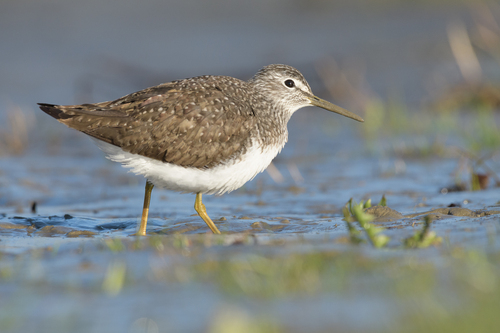
Green Sandpiper
Tringa ochropus
The Green Sandpiper is the elusive hermit of the wetland world, identifiable by its dark, speckled plumage and a startling white rump in flight. Unlike its ground-nesting cousins, this mysterious wader makes its home in the treetops of the northern forests.
Quick Identification
Size
Length: 21–24 cm (8.3–9.4 in); Wingspan: 41–46 cm (16–18 in); Weight: 50–120 g (1.8–4.2 oz)
Colors
Dark greenish-brown upperparts with fine white speckles; brilliant white belly and rump; dark underwings; greenish-grey legs
Key Features
- Distinctive white rump visible in flight
- Dark underwings that contrast sharply with white belly
- Frequent, nervous tail-bobbing motion
- Solitary nature compared to other waders
- Sharp, shrill 'tlee-twee-wit' flight call
When You’ll See Them
Geographic range
Where Does the Green Sandpiper Live?
Native to the vast northern latitudes of the Old World, the Green Sandpiper breeds across the taiga forest belt from Scandinavia through Russia to Siberia. During the winter months, they migrate south to occupy a massive range across Sub-Saharan Africa, the Mediterranean, Southern Asia, and the Philippines. While they are predominantly found in Europe, Asia, and Africa, they are occasionally spotted as rare vagrants on the coastal fringes of North America.
Basemap © OpenStreetMap contributors
Behavior
A fascinating and unique trait of this species is its breeding behavior. While most sandpipers nest on the ground, the Green Sandpiper is an arboreal nester, often taking over the abandoned stick nests of thrushes, crows, or pigeons high in trees. In their wintering grounds, they are creatures of habit, frequently returning to the exact same small ditch or pond year after year, defending their small foraging territory from others.
EverydayEarth exclusive
Camera Tips
Because Green Sandpipers are extremely skittish, a camera with a fast trigger speed (under 0.3 seconds) is essential. They often move with sudden, jerky motions, so a high frame rate or 'burst mode' for photos will ensure you don't end up with a blurry tail-feather. Set your PIR sensitivity to high to catch their light movements, and place the camera in a spot where it has a clear view of the muddy 'transition zone' between the water and the bank.
You won't have much luck with birdseed lures, as these are strictly insectivores. Instead, create a natural 'stage' by ensuring your pond has a shallow, muddy edge without tall grass blocking the camera's view. If you are placing a camera in the wild, look for fresh footprints or small bore holes in the mud where they have been probing for larvae. Early morning light is the best time for recording, as the low sun brings out the subtle greenish sheen on their dark backs which can otherwise look plain black in harsh midday light.
Similar Species
Species that look similar or are commonly confused with Green Sandpiper.
Common Sandpiper
Smaller with a white 'finger' or wedge extending upward between the wing and the breast; it has a more horizontal, crouching posture.
Wood Sandpiper
Lighter, more speckled appearance with a prominent white 'eyebrow' and distinctly yellowish-green legs.
Solitary Sandpiper
The New World relative; very similar but lacks the Green Sandpiper's bright white rump, showing a dark center to the tail instead.
Frequently Asked Questions
Record Green Sandpiper at your habitat
Connect a camera to start building your own species record — AI identifies every visitor automatically.