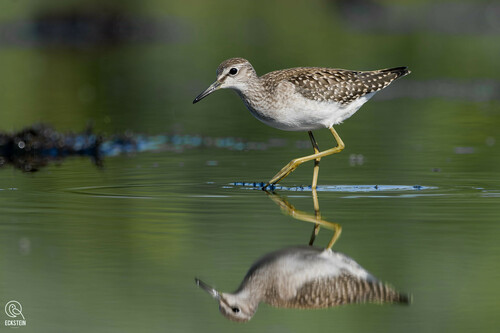
Wood Sandpiper
Tringa glareola
A dappled gem of the wetlands, the Wood Sandpiper is a graceful traveler known for its energetic bobbing and striking white-spotted plumage. Watch for this freshwater specialist as it dances along the muddy edges of ponds during its epic migratory journeys.
Quick Identification
Size
Length: 19-21 cm (7.5-8.3 in); Wingspan: 35-39 cm (14-15 in); Weight: 50-90 g (1.8-3.2 oz)
Colors
Gray-brown upperparts heavily dappled with white spots; white underparts with fine brown streaking on the throat; pale yellowish-green legs; prominent white 'eyebrow' (supercilium).
Key Features
- Distinctive white eyebrow stripe extending behind the eye
- Yellowish or greenish-brown legs
- Square white rump visible only in flight
- Fine white spotting across the wings and back
When You’ll See Them
Behavior
The Wood Sandpiper is a high-energy wader, characterized by its restless nature and a distinctive habit of bobbing its tail up and down while foraging. Unlike many other sandpipers that prefer the coastline, this species is a freshwater specialist. It is often seen patrolling the muddy fringes of ponds, marshes, and flooded fields, moving with a light, dainty step. When startled, it takes flight with a sharp, three-note whistle, showing off its square white rump.
Socially, they are less gregarious than other shorebirds, typically found alone or in small, loose groups rather than dense flocks. During their long-distance migrations, they can be surprisingly bold, occasionally appearing in suburban garden ponds or drainage ditches if the habitat provides enough mud and shallow water. They spend most of their time in a focused search for food, rarely remaining stationary for more than a few seconds.
EverydayEarth exclusive
Camera Tips
Capturing a Wood Sandpiper on camera requires a focus on 'water level' photography. These birds are small and spend their time looking down into the mud; if your camera is mounted too high, you will only see the tops of their heads. Position your camera on a low-profile ground stake or a weighted base just 4-6 inches above the mud line. Aim the lens across a flat expanse of shallow water or mudflat where you have previously seen footprints. This low angle creates a professional, intimate look that highlights the bird’s long legs and the white 'spangles' on its back.
To lure a Wood Sandpiper into your camera's field of view, habitat manipulation is more effective than traditional bait. They are not attracted to birdseed or suet. Instead, focus on creating a 'landing strip'—a flat, very shallow muddy area (less than 2 inches deep) at the edge of a pond. If you have a backyard pond, clearing a small patch of vegetation to expose the mud will make the site irresistible to a passing sandpiper looking for a place to forage during migration.
Lighting and motion settings are your biggest technical challenges. Wood Sandpipers are constant 'bobbers,' meaning their tails and bodies are often in motion even when they are standing in one spot. Use a fast trigger speed (0.2s or less) and set your camera to 'Burst Mode' or 'Photo + Video.' This ensures you catch a frame where the bird's head is still and in focus. Because they are often found in open, bright environments, use an ND filter if your camera allows it, or position the camera so the sun is behind it to avoid silhouetting the bird against reflecting water.
Seasonal timing is everything. In the northern hemisphere, your best chances are during the 'passage' months. Keep your camera batteries fresh and your SD cards empty during late April and again from mid-July through September. Early morning light is particularly effective for this species, as it catches the iridescent quality of the wet mud and the fine details of their plumage without the harsh glare of the midday sun hitting the water.
Similar Species
Species that look similar or are commonly confused with Wood Sandpiper.
Green Sandpiper
Darker overall with much darker underwings in flight and a shorter eyebrow stripe that stops at the eye.
Common Sandpiper
Has a distinct white 'spur' or patch that extends up the shoulder and a more horizontal, crouching gait.
Marsh Sandpiper
Much longer, needle-like bill and longer legs, giving it a more 'stilt-like' appearance than the Wood Sandpiper.
Frequently Asked Questions
Record Wood Sandpiper at your habitat
Connect a camera to start building your own species record — AI identifies every visitor automatically.