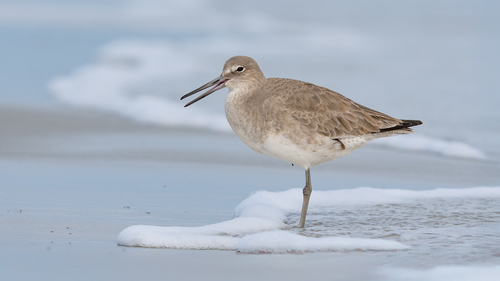
Willet
Tringa semipalmata
The Willet is the coastal sentinel of the shorebird world, instantly recognizable by its piercing cry and dramatic wing patterns. Whether stalking the surf for crabs or guarding a marshy nest, this robust sandpiper is a master of the shoreline.
Quick Identification
Size
Length: 13-16 in (33-41 cm); Wingspan: 24-31 in (60-80 cm); Weight: 7-12 oz (200-350 g)
Colors
Mottled gray-brown upperparts and pale underparts; distinctive bold black-and-white stripes on wings visible in flight; blue-gray legs.
Key Features
- Heavy, straight, blue-gray bill
- Bold black-and-white wing stripes visible during flight
- Sturdy, medium-length blue-gray legs
- Large, robust sandpiper silhouette
- Loud, piercing 'pill-will-willet' call
When You’ll See Them
Behavior
Willets are known for being one of the most vocal and conspicuous shorebirds. While they may appear as rather plain, gray-brown birds while standing, they undergo a dramatic transformation when they take flight, revealing a startling black-and-white wing pattern. This 'flash' is often accompanied by their namesake call, a piercing 'pill-will-willet' that can be heard across salt marshes and beaches.
These birds are fiercely territorial during the breeding season, often perching on fence posts or bushes to keep watch over their nesting site. They are social outside of the breeding season and can be found in small flocks, though they are less tightly packed than many other sandpiper species. Their interaction with humans is usually cautious; they will often be the first birds to sound an alarm if you walk too close to a nesting area.
EverydayEarth exclusive
Camera Tips
To capture the Willet on an AI-powered camera, placement is everything. If you live near a salt marsh or a coastal backyard, position your camera low to the ground, ideally 12-18 inches high, facing a mudflat or a sandy shoreline where the tide recedes. These birds love to forage at the water's edge, so aiming your camera at the 'wrack line' (the line of debris left by high tide) is a high-probability strategy for capturing feeding behavior.
Because the Willet’s most striking feature is its black-and-white wing pattern, you want to set your camera to 'Burst Mode' or high-speed photo capture. The trigger speed needs to be as fast as possible to catch them mid-takeoff. Standard trail cameras can often be too slow, but if you can adjust the sensitivity, set it to 'High' to ensure you don't miss the motion of a bird landing or stretching its wings. Use a wide-angle lens if available to capture the full wing span when they inevitably take flight.
Timing your monitoring with the tides will yield much better results than sticking to a strict solar schedule. Willets are most active during a falling tide when new mud is exposed, revealing fresh snacks. If you are in the Western US trying to catch the inland subspecies, look for damp pastures or the edges of prairie potholes during the spring. Avoid using artificial lures or food, as shorebirds are highly specialized; instead, provide a shallow, natural-looking water feature or simply maintain a quiet, chemical-free shoreline to attract the invertebrates they crave.
Similar Species
Species that look similar or are commonly confused with Willet.
Frequently Asked Questions
Record Willet at your habitat
Connect a camera to start building your own species record — AI identifies every visitor automatically.