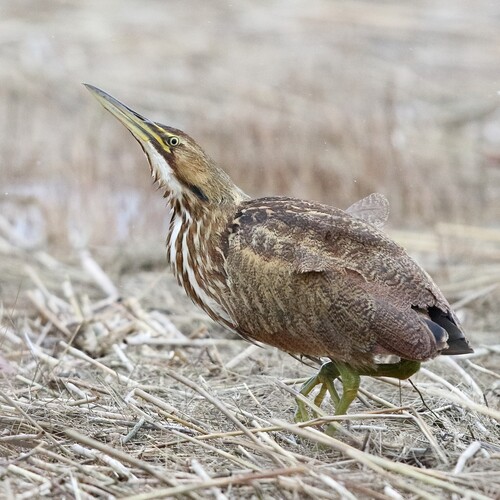
American Bittern
Botaurus lentiginosus
A master of disguise and a phantom of the marsh, the American Bittern is famous for its 'sky-pointing' camouflage and its strange, booming voice. Discover the secrets of this elusive wetland hunter.
Quick Identification
Size
Length: 60–85 cm (24–33 in); Wingspan: 92–115 cm (36–45 in); Weight: 370–1,072 g (0.8–2.4 lbs)
Colors
Streaked brown, buff, and white plumage; black patch on the side of the neck in breeding adults; yellowish-green legs and yellow eyes.
Key Features
- Stocky build with a thick, powerful neck
- Vertical brown and white neck streaks for camouflage
- Distinctive 'sky-pointing' freeze posture
- Long, pointed yellow-to-brown bill
When You’ll See Them
Geographic range
Where Does the American Bittern Live?
The American Bittern is native to North America, where it maintains a broad breeding range across Canada and the northern to central United States. During the winter months, these birds migrate to the southern U.S. states, particularly the Gulf Coast and Florida, as well as Mexico, the Caribbean, and parts of Central America. They are highly dependent on expansive wetland systems and are rarely found far from dense marshy cover.
Basemap © OpenStreetMap contributors
Behavior
The American Bittern is a solitary and highly secretive wading bird, famous for its incredible camouflage. When it senses a threat, instead of flying away, it stretches its neck upward, points its bill toward the sky, and sways gently to mimic the movement of the surrounding reeds and grasses. This 'sky-pointing' behavior makes it nearly invisible to predators and human observers alike.
Unlike many other herons that are social, the American Bittern is a 'loner' that spends most of its time tucked away in dense marsh vegetation. It is most frequently heard rather than seen, producing a unique, low-frequency booming call often described as 'pump-er-lunk.' This sound is produced by the bird inflating its esophagus and can carry for long distances across the marsh.
EverydayEarth exclusive
Camera Tips
To capture an American Bittern on a trail camera, placement is everything. These birds are masters of the 'edge' zone—the transition area between open water and thick reeds. Position your camera at a low angle, roughly 18 inches off the ground, facing a small natural opening or a 'game trail' leading into the cattails. Because they are often stationary for long periods, avoid using cameras with slow trigger speeds; instead, look for models with high-sensitivity PIR sensors or a fast recovery time to catch them the moment they strike at prey.
Since Bitterns are most active during the low-light hours of dawn and dusk, ensure your camera has high-quality infrared (no-glow) LEDs. This will allow you to capture clear black-and-white footage of their hunting behavior without startling them. Setting your camera to record short video clips (15-30 seconds) is often more rewarding than still photos, as it allows you to see their iconic swaying 'reed mimicry' and hear their bizarre booming calls if your camera has a built-in microphone.
Avoid using food lures, which are ineffective for these solitary hunters. Instead, look for physical signs of their presence like large, four-toed footprints in the mud or flattened areas in the reeds. If you have a backyard pond with tall grass edges, keeping the area quiet and undisturbed during the spring breeding season is the best way to encourage a resident Bittern to pass through your camera's field of view.
Similar Species
Species that look similar or are commonly confused with American Bittern.
Least Bittern
Much smaller in size with large buffy wing patches and a darker crown and back.
Green Heron
Smaller and darker with a velvet-green back and rich chestnut neck; lacks the vertical brown-and-white streaking.
Juvenile Black-crowned Night-Heron
Similar brown streaking but has a thicker bill and lacks the American Bittern's black neck streak and sky-pointing behavior.
Frequently Asked Questions
Record American Bittern at your habitat
Connect a camera to start building your own species record — AI identifies every visitor automatically.