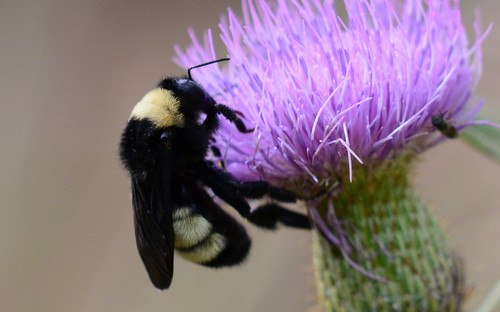
American Bumble Bee
Bombus pensylvanicus
The American Bumble Bee is a majestic, fuzzy pollinator and a cornerstone of the North American prairie. By tracking this vulnerable species in your backyard, you're contributing to vital conservation efforts for our native ecosystems.
Quick Identification
Size
Queens: 20-25 mm (0.8-1 in); Workers: 13-19 mm (0.5-0.75 in); Males: 17-22 mm (0.6-0.85 in)
Colors
Bright yellow on the front of the thorax, a black band across the middle, and yellow on the first three segments of the abdomen; tail is black.
Key Features
- Distinct black band between the wings on the thorax
- Abdominal segments 1 through 3 are yellow
- Abdominal segments 4, 5, and 6 are black
- Long, narrow face compared to other bumble bee species
When You’ll See Them
Geographic range
Where Does the American Bumble Bee Live?
The American Bumble Bee is native to North America, historically maintaining a massive presence from southern Ontario and Quebec in Canada throughout most of the continental United States and into central Mexico. While it has seen a significant range contraction in the Northeast, it remains most frequently observed in the Great Plains, the Midwest, and the southern states. This species thrives in open, sun-drenched landscapes where native wildflowers are abundant.
Basemap © OpenStreetMap contributors
Behavior
American Bumble Bees are social insects that live in annual colonies founded by a single queen. Emerging in late spring, the queen meticulously selects a nesting site—usually an abandoned rodent burrow or a thick clump of grass—where she begins the colony's first generation. They are famous for their 'buzz pollination,' a technique where the bee vibrates its thoracic muscles at a specific frequency to dislodge pollen from flowers that other insects cannot access.
In the backyard, they are remarkably peaceful foragers. Unlike social wasps, they rarely show aggression toward humans unless their nest is physically disturbed. They exhibit a 'traplining' foraging strategy, meaning they follow a regular route between favorite flower patches, making them predictable visitors for those hoping to capture them on camera. As the season ends, only the new queens survive by hibernating underground, while the rest of the colony perishes with the first hard frost.
EverydayEarth exclusive
Camera Tips
To capture the best footage of an American Bumble Bee, position your AI-powered camera near high-value 'landing pads.' These bees are particularly attracted to tall, sturdy stalks like Purple Coneflower (Echinacea), Bee Balm (Monarda), or Sunflowers. Set your camera height to match the height of the blooms, typically 2 to 4 feet off the ground, and angle it slightly upward. This upward angle is crucial because it helps the camera capture the bee’s long face and the specific yellow-and-black banding on the underside of the abdomen, which are key for positive identification.
Lighting is your best friend when it comes to insect photography. Place your camera in a location that receives full sun during the peak activity hours of late morning and early afternoon. Direct sunlight not only allows for a faster shutter speed to freeze the motion of their wings but also makes the yellow hairs 'pop' against the green background. Avoid busy, leafy backgrounds that might confuse the AI’s focus; a clean line of sight to a single flower cluster is ideal.
If you are using a camera with video settings, use the highest frame rate available (60fps or 120fps). American Bumble Bees move with a heavy, deliberate flight pattern, but their wings are still a blur to the human eye. Slow-motion playback is the best way to observe the buzz pollination process. Since these bees are 'trapliners,' they will likely return to the same flower at a similar time each day, so if you miss the shot today, keep your camera in the same spot for tomorrow.
Similar Species
Species that look similar or are commonly confused with American Bumble Bee.
Frequently Asked Questions
Record American Bumble Bee at your habitat
Connect a camera to start building your own species record — AI identifies every visitor automatically.