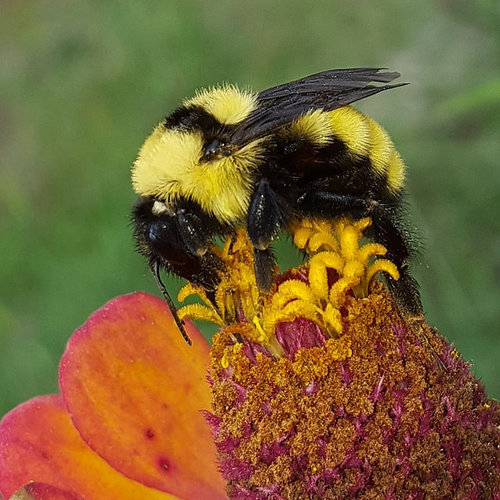
Golden Northern Bumble Bee
Bombus fervidus
A vibrant golden herald of the summer meadow, the Golden Northern Bumble Bee is one of the most striking and industrious pollinators in the backyard.
Quick Identification
Size
Length: 0.4–0.8 inches (10–21 mm); Queens are the largest, while workers and drones are significantly smaller.
Colors
Densely covered in bright yellow hairs on the thorax and first four segments of the abdomen; black band between the wings; black tip on the tail.
Key Features
- Yellow hairs cover the abdomen almost entirely to the tip
- Broad black band across the thorax between the wing bases
- Long tongue specialized for deep, tubular flowers
- Large, robust build with a fuzzy appearance
When You’ll See Them
Behavior
The Golden Northern Bumble Bee is a social insect that lives in colonies founded by a single queen each spring. Unlike many of their more docile relatives, this species is famous among entomologists for its spirited nest defense. When threatened, workers have been known to engage in 'honey-daubing,' where they smear intruders or rival insects with sticky nectar and honey to incapacitate them and drive them away from the colony.
In the garden, they are tireless workers, often active from early morning until dusk. Because they possess longer tongues than many other bee species, they are specialized foragers. You will often see them hanging onto vertical flower spikes, working their way from the bottom to the top. They are generally peaceful toward humans while foraging, only becoming defensive if their nest—usually tucked away in a clump of tall grass or an abandoned rodent burrow—is disturbed.
EverydayEarth exclusive
Camera Tips
To capture high-quality footage of the Golden Northern Bumble Bee, your best bet is a 'floral stakeout' rather than searching for their elusive ground nests. Position your AI camera within 12 to 18 inches of tall, tubular flowers like Bee Balm, Foxglove, or Salvia. These bees are long-tongued specialists, so they will spend more time on these complex blooms compared to flat, open daisies, giving your camera's autofocus more time to lock on.
Because these bees are fast-moving, use a high shutter speed if your camera allows manual overrides, or ensure the area is brightly lit by direct sunlight to help the sensor freeze the motion of their wings. Angle your camera slightly upward from a low position to capture the golden abdomen and the distinctive black stripe on the thorax. Side-profile shots are especially useful for distinguishing them from the similar-looking American Bumble Bee.
If you are looking for more candid social behavior, look for them in the late afternoon during the peak of summer. During this time, you may catch 'patrolling' drones or workers returning heavily laden with bright orange pollen baskets on their hind legs. Avoid using macro lenses with too shallow a depth of field, as the bee's movement toward and away from the flower can easily lead to blurry shots; a medium-range focus often yields more consistent results for identification.
Similar Species
Species that look similar or are commonly confused with Golden Northern Bumble Bee.
American Bumble Bee
The American Bumble Bee has a blacker thorax and the yellow on its abdomen usually ends earlier than the Golden Northern's.
California Bumble Bee
Nearly identical in appearance but found primarily in the Western United States; requires geographic context for certain ID.
Common Eastern Bumble Bee
Much less yellow on the abdomen; usually only the first segment is yellow, while the rest is black.
Frequently Asked Questions
Record Golden Northern Bumble Bee at your habitat
Connect a camera to start building your own species record — AI identifies every visitor automatically.